


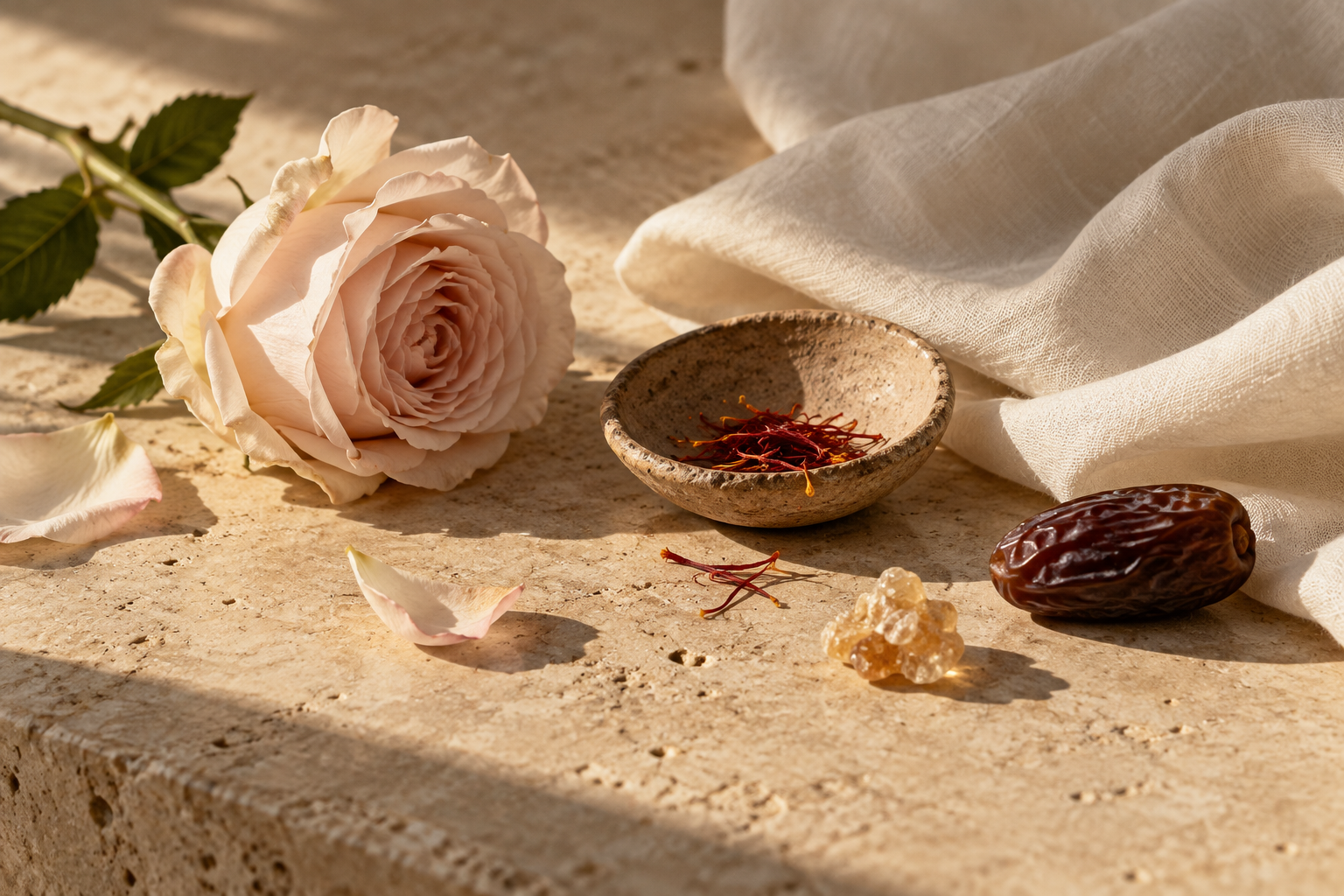
I would begin with flowers. A rose should not have to explain where the oud has gone.
Middle Eastern perfumes are so often introduced in a determined atmosphere of darkness: heavy wood, a low light, something smoldering in the background. Meanwhile, a bottle from Oman is talking about water violet and green leaves. Another is bringing lychee to a rose. I would like to open a window and let those two speak first.
A green leaf, then a rather cheerful rose
Water violet, freesia and green leaves begin the published note sequence of Amouage Reflection Woman. Magnolia, ylang-ylang and jasmine follow; amber, musk, cedarwood and sandalwood complete the eau de parfum’s palette.
The leaves catch my attention before the flowers do. They make me think of a stem still slightly too long for its vase, a little piece of the outside world left attached. I like that incompleteness. A perfect bouquet can occasionally seem to have been arranged out of all recognition.
Then there is magnolia, and the fuller company of jasmine and ylang-ylang. The note list lets the picture open out rather than stay suspended in its first green moment. That movement matters to someone choosing a floral for a whole day: the cool entrance is only part of what is being offered. The wood and musk belong to the choice as well.
Reflection Woman is a useful place to begin precisely because it unsettles the regional costume before we have become comfortable with it. No oud appears in that published palette. There is nothing missing from the description that needs an apology.
Rose takes a different turn in Swiss Arabian Rose 01, linked here in its 50 ml extrait de parfum version. Lychee, bergamot and pink pepper lead towards rose and peony, with vanilla, musk and cashmere wood beneath them.
Lychee and rose have an immediately cheerful look on the page. I picture an unexpectedly bright earring on an otherwise rather proper woman. She has no intention of taking it off. The pink pepper is another small point of animation in the opening; the vanilla base suggests that the fruit is not the whole account of its sweetness.
I would put Rose 01 beside Reflection Woman for the pleasure of the difference. One description arrives with greenery; the other makes room for fruit around the flowers. Neither needs to become an example of a single regional smell. They already have enough personality to disagree.
Before the next bottle, a word about the label
These examples come from houses rooted in Oman and the United Arab Emirates. Amouage was founded in Oman in 1983. Lattafa describes its Emirati heritage; Afnan identifies its UAE roots. Those are facts about the houses. A fragrance’s floral character, its use of resin or its sweetness is another kind of information.
“Middle Eastern perfume” can name an origin, an inspiration or a retailer’s category. The three do not fit neatly on top of one another. A perfume from elsewhere may take oud and rose as its subject; an Omani composition may lead with green leaves. The bottle’s address and its character are worth getting to know separately.
I dislike the costume a broad label can make us expect. It leaves very little room for a perfume to be cool, peculiar, restrained, excessively sweet, wonderfully floral or simply unlike the last one. Nor does a house’s location establish that a particular scent resembles a familiar designer fragrance. A comparison needs two actual compositions, not a rumor attached to a region.
The history I would pause over here begins with a tree. In southern Oman, UNESCO’s Land of Frankincense brings together the frankincense trees of Wadi Dawkah, the caravan oasis of Shisr and the old ports of Khor Rori and Al-Baleed. Together they record centuries of production and trade. Resin moved from the landscape into a network of journeys, long before it could become a word on a modern perfume page. Even the map gives scent a little more air.
There is a different scale again when fragrance is offered to a room. Saudipedia describes bukhoor as part of welcoming guests in Saudi Arabia, with incense scenting houses in preparation for a visit. The recipient is, in a sense, the gathering. Abu Dhabi’s official tourism guide distinguishes oud burned as wood or chips from oud oil worn as perfume. Smoke entering a room, oil applied to the body, a spray chosen by its full name: those are different ways of giving scent a place in the day. They should not disappear into one adjective about strength.
Guidance carries frankincense in its published palette, beside pear and hazelnut. That modern composition is a different object from incense burning in a vessel; its note list does not establish that its resin came from the UNESCO sites. I like following the word across those settings without insisting that they smell alike. Reflection Woman’s green leaves and flowers can then remain entirely themselves. A creative house has more to draw on than a single inherited picture.
The five perfumes here offer a focused introduction to Gulf houses from Oman and the UAE, rather than a catalogue of the whole Middle East. The Saudi and Emirati customs above open a little cultural space around the bottles; they do not prescribe how everyone in a vast region wears perfume. There are more lives for scent than five atomizers can hold.
Our Arabian oud perfume guide follows that particular woody interest more closely. Here I want to keep the door open for other subjects. Musk is waiting, with what appears to be a very short speech.
Afnan Pure Musk, and the temptation to call something simple
Afnan Pure Musk is listed as a 100 ml eau de parfum. Floral musk, white musk, a musky heart and sweet musk in the base: the description stays almost stubbornly with one subject.
After the flowers and fruit, that concentration of attention is appealing. There is something satisfying about a label that refuses to open another drawer. Yet even this apparently narrow vocabulary contains decisions. Floral, white and sweet do not suggest precisely the same effect. Musk in a finished perfume can have powder, sweetness and considerable presence around its clean associations.
A freshly pressed shirt is the image that comes to mind. I should be careful with that image: in fragrance shopping, “clean” is too easily mistaken for “quiet.” A perfume can suggest cleanliness and still announce itself across a small room. This is a reason to begin with a small application, not a reason to abandon the idea.
Pure Musk is the useful pause in this selection. If its musky direction is what attracts you, it helps separate the wish for a particular finish from the wish for a great many named notes. Complexity on a product page and pleasure in a perfume are not the same measurement.
Khamrah has put a flower among the dates
Bergamot, cinnamon and nutmeg introduce Lattafa Khamrah. Dates, praline and tuberose occupy the next part of its published palette; vanilla, tonka, benzoin, myrrh and woody notes form the base.
Dates and praline give a fairly clear idea of the invitation. I enjoy that frankness. The more curious detail is tuberose, a large flower turning up amid all the spice and confectionery richness. Once noticed, it stops the description from reading like an elaborate dessert menu.
There is also the question of what warm means. Cinnamon supplies one association; the rounded richness of praline supplies another. Myrrh and benzoin bring resin into the same picture. A perfume can move among these kinds of warmth, and the part that catches you at first may not be the part that remains most important.
The cinnamon is easy to imagine first, perhaps too easy. It is a vivid word with the power to recruit a whole bakery into the mind. Tuberose takes a little longer to fit into that scene. Myrrh belongs to another scene again. I would rather leave those associations slightly unsettled than make the perfume illustrate only one of them.
Set it against Rose 01 and an interesting difference appears. Vanilla belongs to both published bases, but the supporting worlds are quite different: fruit and rose in one, dates, praline, spice and resin in the other. “I like vanilla” can begin the conversation. It cannot finish all of it.
Guidance is where the tidy categories come apart
Then Amouage Guidance Eau de Parfum brings pear, frankincense and hazelnut into the opening, followed by saffron, rose, jasmine sambac and osmanthus. Cistus, sandalwood, Akigalawood, ambergris and vanilla form the published base.
Hazelnut beside frankincense is the small collision I keep returning to. It makes me want to move the fragrance out of whichever drawer I had prepared for it. Fruit and a nut might suggest a gourmand; the flowers complicate that expectation; incense gives the whole thought another direction.
I love the apparent confidence of putting all those interests together. No single one is obliged to become a slogan. Amouage itself describes Guidance around rose, frankincense and ambergris, which is a useful reminder that the most unusual word on a note list is not necessarily the structural center of the perfume.
That leaves room for a more interesting encounter than hunting for hazelnut alone. Notice what holds the composition together for you. It might be the flowers, the relationship between fruit and resin, or the warmth around the base. None of those discoveries would invalidate the first spark of curiosity.
There is a separate thread to follow in our guide to frankincense perfume. I would keep it as a side door rather than force Guidance to become an illustration of incense. With Reflection Woman in the same selection, it also becomes possible to see two very different floral arrangements from one house. That is more revealing than making either bottle stand for an entire region.
Some words describe an idea; others identify the product
Dates, praline, cashmere wood: perfume notes evoke effects and associations. They are not a complete recipe or proof that a named natural ingredient is present. I enjoy a detailed note list, but it can become a very persuasive fiction if we begin reading it as a shopping list for the formula.
Other words need considerably less imaginative freedom. Eau de parfum, extrait and perfume oil identify formats or versions that must be checked on the actual listing. A similarly named oil and spray can be different compositions. The volume, concentration and application method belong beside the full name when you compare a sample or a review with a purchase.
Alcohol-free status needs the same care. Guidance and Reflection Woman list alcohol among their ingredients. Geography cannot answer that question, and neither can an oud or musk note. If the formula matters to your decision, consult the current ingredient information for the exact version or ask the house.
Our guide to perfume oils for women examines that format more closely. Follow the particular product’s directions. Oil, spray and a higher stated concentration do not promise a fixed lasting time or a particular trail in the air. They also cannot decide whether you will enjoy the scent, which remains a rather important omission in any discussion devoted entirely to strength.
Make a small selection with some life in it
I would choose one familiar pleasure and one departure. Reflection Woman and Rose 01 keep flowers at the center while changing the greenery and fruit around them. Khamrah and Guidance give spice, richness and resin different roles. Pure Musk offers a way out of the crowded conversation altogether.
Wear each sample alone first, with body products that do not add a strong scent of their own. Paper can narrow the selection; give a full-bottle candidate a separate trial on skin. Return after the opening, then later again. Useful notes can be very plain: wanted more rose, loved the resin, sweetness became too much. There is no examination in which “opulent” earns extra marks.
Include the setting. A fragrance for a desk with colleagues nearby may need a smaller application than the same bottle worn for an evening. Enjoying a dramatic first encounter and wanting that presence through an ordinary afternoon are separate judgments. Layering can wait until the individual perfume is familiar.
The unromantic minute before ordering
For a purchase from the United States, establish the exact name and format on the house’s product page, then identify the seller. An official regional store, an authorized retailer and an independent marketplace listing call for different checks. Use the house’s retailer directory where one is available.
Compare the checkout total in US dollars, including shipping, tax and applicable import charges. A dollar sign does not establish domestic shipping. Check the destination, bottle size, concentration and return terms before opening anything. If a discovery set promises credit towards a bottle, read the actual conditions of that credit.
Decants and samples need a clear seller, label and volume. A beautiful sample tells you about a perfume; it says nothing about another retailer’s stock or delivery. The final listing deserves a fresh look when you are ready to buy.
Then I would go back to the green leaves. They were a fine way to open the window.
