


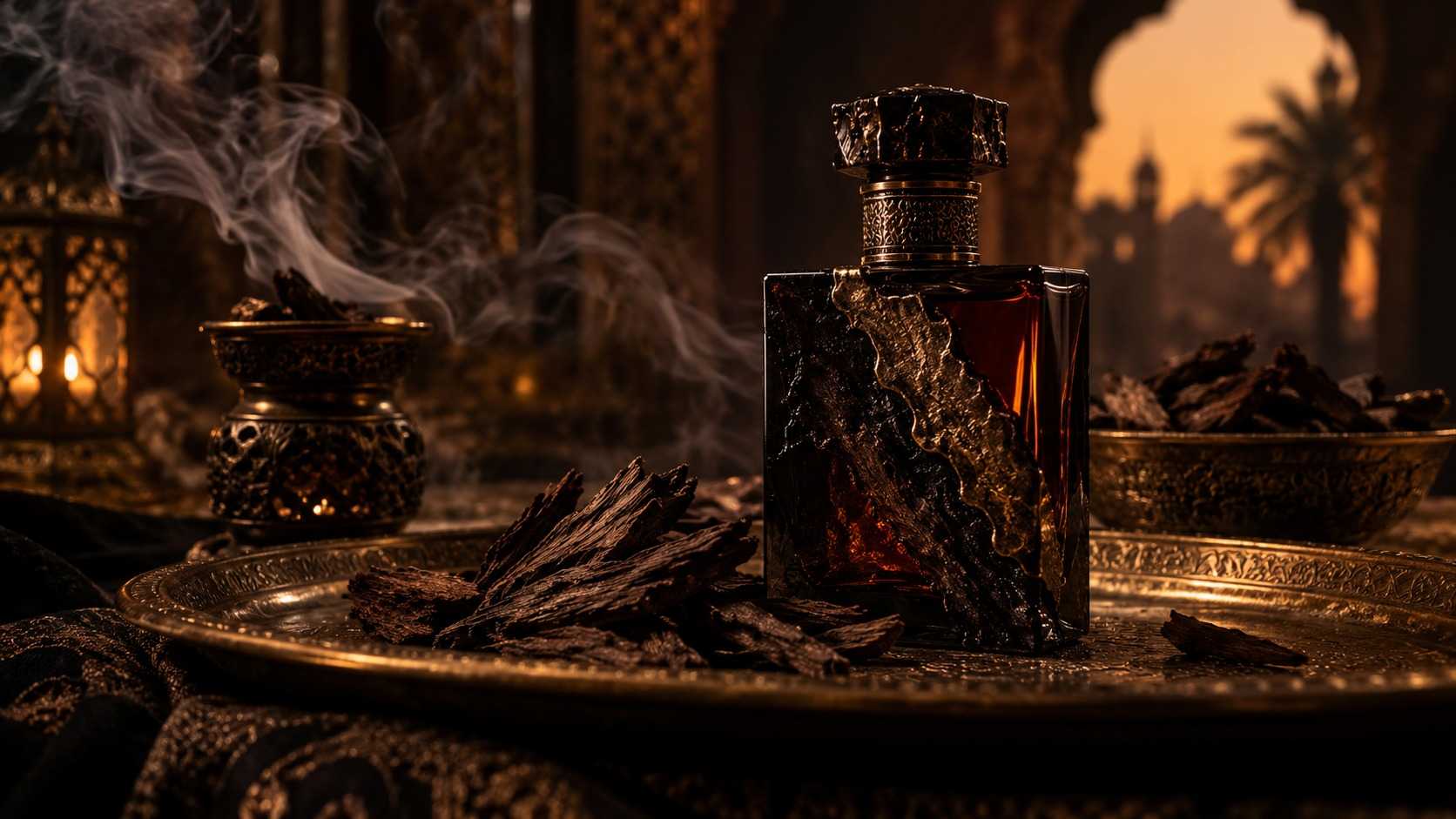
Arabian oud perfume is not one single smell. The phrase is used for a broad range of fragrances associated with Middle Eastern perfumery, from concentrated oils and rose-oud blends to polished Western-style sprays built around saffron, amber, leather, smoke, or vanilla. Some are dense and ceremonial; others are surprisingly bright and easy to wear.
This guide explains the styles commonly grouped under “Arabian oud,” how oil and spray formats differ, what to expect from strength and drydown, and how to choose without assuming that every oud perfume is dark, animalic, or overwhelmingly sweet.
What Is Oud?
Oud, also called agarwood, refers to resin-rich wood formed in certain Aquilaria and related trees. The aromatic material is prized because it can produce an unusually complex spectrum: dry wood, smoke, leather, earth, sweetness, medicine, fruit, balsam, or animalic depth.
Natural oud materials vary greatly by species, region, age, processing, and quality. Many modern perfumes also use accords and aroma materials to create or support an oud effect. A note list that says “oud” therefore describes an artistic direction, not a guarantee of one standardized raw material.
For the broader ingredient story, start with our oud perfume guide.
What Does “Arabian Oud Perfume” Usually Mean?
The label often signals one or more of the following:
- a composition influenced by Gulf and wider Middle Eastern fragrance traditions;
- a strong concentration or persistent base;
- oud paired with rose, saffron, amber, musk, smoke, leather, or sweet notes;
- an oil-based attar or concentrated perfume oil;
- a richer style intended for layering or ceremonial wear.
It does not prove the geographical origin of the oud material, the percentage of natural agarwood, or the cultural authenticity of the composition. Those are separate claims that require specific information from the brand.
Five Common Arabian Oud Styles
1. Rose oud
Rose softens oud while oud gives rose shadow and structure. The result can be velvety and romantic, dry and spicy, or intensely jammy. If you like this pairing but want to understand its range, see the rose oud perfume guide.
2. Saffron leather oud
Saffron can feel dry, leathery, warm, slightly mineral, or hay-like. Paired with leather and oud, it produces a tailored, assertive scent with less floral sweetness.
3. Amber oud
Amber materials, vanilla, labdanum, and resins round the wood and make it more enveloping. Some amber-oud perfumes are sweet and plush; others are smoky and dry.
4. Tobacco oud
Tobacco, honey, spice, and woods create a darker, textured style. The tobacco may feel leafy, sweet, smoky, or leathery. Our guide to oud tobacco fragrances explores that direction.
5. Fresh or modern oud
Citrus, aromatic herbs, clean musk, and transparent woods can make oud easier for daytime. In these perfumes, oud may appear mainly in the drydown rather than dominating from the first spray.
Oil, Attar, and Eau de Parfum
| Format | Typical behavior | Best for | Watch for |
|---|---|---|---|
| Perfume oil or attar | Applied close to skin; often concentrated and slow to unfold | Layering, controlled application, intimate wear | Small amounts can be powerful; oil may stain delicate fabric |
| Eau de parfum spray | Creates a larger scent cloud and more immediate diffusion | Everyday use and easier distribution | Projection may be stronger than expected |
| Extrait or highly concentrated spray | Dense, persistent, often slower in development | Statement wear and cool weather | Price and concentration do not automatically guarantee nuance |
Oil is not inherently more authentic, and spray is not inherently less luxurious. They are delivery systems with different behavior.
How Strong Is Arabian Oud Perfume?
Many oud compositions are built for persistence, but strength varies. A sweet amber-oud fragrance may project broadly. A naturalistic oud oil may remain closer to skin but last for many hours. A modern transparent oud may be easier and lighter than its name suggests.
Evaluate three dimensions separately:
- projection: how far the scent travels;
- longevity: how long it remains detectable;
- density: how heavy or textured it feels.
A perfume can be long-lasting but quiet, or loud in the first hour and much softer later.
How to Choose by Scent Profile
| If you want… | Look for… | Avoid or test carefully… |
|---|---|---|
| Soft, romantic oud | Rose, jasmine, musk, sandalwood | Very smoky leather and medicinal oud |
| Warm, sweet oud | Amber, vanilla, honey, benzoin | Dense sweetness in hot weather |
| Dry, tailored oud | Saffron, leather, cedar, pepper | Highly animalic materials if you prefer clean scents |
| Dark, smoky oud | Incense, tobacco, cypriol, charred woods | Small rooms and generous spraying |
| Daytime oud | Citrus, herbs, clean musk, transparent woods | Assuming “oud” always means heavy |
A Maison IRFĒ Example
Smoldering Pepper Eau de Parfum presents oud inside a spicy, smoky structure rather than as a solitary material. Black pepper, saffron, and olibanum open the composition. Labdanum, Indonesian patchouli, and cypriol form the heart, while bourbon vanilla, smoked leather, and oud shape the base.
This is a useful example of a modern oud-spice fragrance: the perfume has warmth and darkness, but pepper and olibanum give it movement. It also shows why “oud” alone cannot predict the full experience.
The Maison IRFĒ Discovery Set allows comparison with rose, saffron leather, powdery musk, and tobacco-patchouli styles before choosing a full bottle.
How to Apply Oud Perfume
- Begin with less than usual. One spray or a small oil touch may be enough.
- Let the perfume warm. Oud compositions often change substantially after twenty to sixty minutes.
- Avoid rubbing wrists. Let the perfume evaporate naturally.
- Test on skin and fabric separately. Fabric can hold the scent longer, but oils and dark liquids may stain.
- Respect shared spaces. Strong oud is best applied with the room and company in mind.
Layering Oud
Layering is common in many fragrance traditions, but more is not automatically better. Oud can be paired with:
- rose for floral richness;
- musk for softness;
- vanilla or amber for warmth;
- saffron and leather for dryness;
- citrus for lift;
- tobacco for depth.
Start with the denser scent, then add a lighter accent. Test the combination privately before wearing it in public. Two powerful fragrances can create muddiness rather than complexity.
Common Oud Buying Mistakes
- Treating “Arabian” as one fixed formula. The category includes many regional and commercial styles.
- Assuming price proves natural oud content. Ask for specific sourcing and formula information if that matters to you.
- Testing too many at once. Dense resins and woods quickly fatigue the nose.
- Judging only the opening. Medicinal, smoky, or sharp facets may soften dramatically.
- Overspraying in cold air. The perfume may seem quiet outdoors and then expand indoors.
- Buying a full bottle from a note list. Oud’s variability makes sampling especially important.
Cultural Context Without Stereotypes
Oud has deep histories across South and Southeast Asia, the Middle East, and perfumery markets around the world. It should not be reduced to a costume of gold bottles, extreme sweetness, and generic “exotic” language. A respectful description focuses on materials, formats, craft, and actual fragrance structure.
Likewise, a Western-style spray containing an oud accord is not the same experience as a traditional oil. Both can be well made; they simply belong to different product contexts.
Sourcing and Conservation
Agarwood is a high-value material, and several source species are subject to international trade controls. Brands that make specific claims about natural oud, origin, or sustainability should provide traceable information rather than relying on price or an “exclusive” story. A perfume can be beautiful with a constructed oud accord, but the description should be honest about what is being sold.
Consumers do not need to become timber experts. Useful questions are simple: Is natural oud specifically claimed? Is the origin identified? Is the brand describing an accord instead? Is there documentation for a sustainability claim? Transparency matters more than romantic language.
How to Avoid Nose Fatigue
Oud, amber, musk, and modern woody materials can cause temporary adaptation, making the wearer think the perfume has vanished. Test one fragrance at a time, avoid repeated close sniffing, and check the scent from normal distance. Ask another person only after the perfume has settled, not immediately after spraying.
Frequently Asked Questions
Is Arabian oud perfume always very strong?
No. Many are powerful, but transparent sprays and close-wearing oils also exist. Check concentration, supporting notes, and real wear behavior.
Is oud masculine or feminine?
Oud has no inherent gender. Rose, musk, and vanilla may make it softer; leather, smoke, and dry woods may make it more severe.
Why does oud sometimes smell medicinal?
Certain oud materials and accords can show bitter, phenolic, leathery, or medicinal facets. These may soften in the drydown or remain central to the style.
Can oud be worn in summer?
Yes, but lighter citrus, aromatic, musky, or rose styles are usually easier than dense sweet amber-oud compositions.
Should I buy oil or spray?
Choose oil for close, controlled application and spray for easier diffusion. Sample both if possible.
Final Takeaway
Arabian oud perfume is best approached as a family of styles, not a single intimidating scent. Decide whether you want rose, saffron leather, amber, tobacco, smoke, or a fresher modern structure. Then test strength and drydown on skin. The right oud should feel deliberate, not merely powerful.
