


The temptation is to keep adding. A little rose, something woody, perhaps that vanilla, and suddenly every bottle on the dressing table has been invited. I would stop at two.
Perfume layering becomes interesting when the second fragrance changes one particular thing. A familiar rose acquires a darker outline. A vanilla gets a little air around it. Something you know very well becomes slightly strange again, while keeping the detail that made you love it.
Choose a lead scent, give the second one a clear role, and begin with small amounts. Compare the fragrances alone, together on paper, then on skin. The bottles themselves can stay separate. There is plenty to discover without committing an entire flacon to an afternoon’s curiosity.
Begin with the thing you want to keep
A good starting fragrance is one you know beyond its opening. You already recognize the flowers that appear later, the warmth that stays, the point at which it becomes too sweet for your mood. That familiarity gives a second perfume something precise to change.
I would write the wish before choosing the partner. More wood around the vanilla. A little leather beside the rose. Less of the very soft finish, perhaps. “Make it more interesting” asks quite a lot of a small sample, and gives you almost no way to judge the answer.
There is also the possibility that the original perfume is already right. I like leaving that possibility on the table. A second bottle need not be a compulsory demonstration of individuality; the fragrance you chose alone was an individual choice, too.
When you do want an accent, read its whole description. A citrus opening may introduce a substantial amber base. A woody perfume can be richly sweet. Shared rose, sandalwood or musk notes offer a point of connection, but a note pyramid is neither the full formula nor a reliable measure of strength. Two bottles with “rose” on their pages can bring very different company to the meeting.
Paper makes an excellent rehearsal room
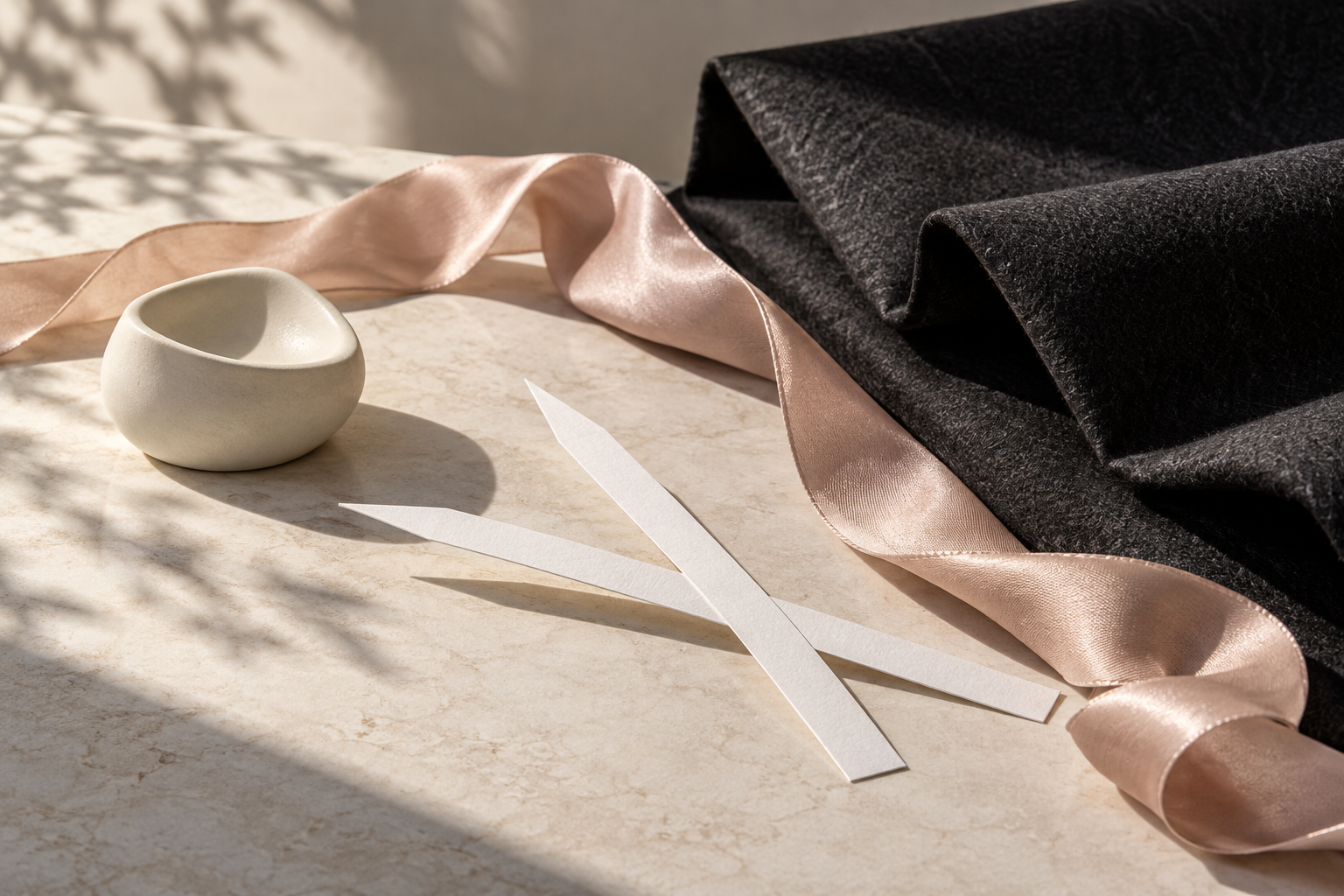
Label two blotters and apply one perfume to each. Allow the wet opening to settle, smell the strips separately, then bring them together. Move them apart again. It is a wonderfully low-commitment way to hear what the second fragrance contributes.
Something you adored alone may be the wrong partner. Sweetness can double up; a striking accent can drown out the flower you meant to frame. Paper does not reproduce skin, but it can save you from spending the next few hours inside an idea that was more attractive in theory.
Keep the strips. Return after they have moved beyond their openings. The woody, warm or musky parts may change the relationship considerably, and that later arrangement deserves a vote. If the pair still interests you, it has earned a separate skin trial.
For an additional paper experiment, use a fresh labeled blotter for a small overlapping application of the two. Compare it with the separate strips. This keeps the first, reversible comparison available while showing you what happens when the sprays actually share a surface.
On skin, change one thing at a time
Begin below your usual total application. Two perfumes each receiving their ordinary solo dose can become a very large fragrance, whatever the delicacy of the idea. Small sample amounts are easier to adjust than a generous opening declaration.
Atomizers vary. One spray from each bottle does not necessarily mean equal amounts, and equal amounts do not mean equal presence. Think of lead and accent as roles in the composition you want to smell, not as instructions to give both bottles the same turn.
- Try separate placement first. Use separate areas of a forearm, near enough to smell together while retaining access to each perfume. Sometimes that relationship in the air is already the result you wanted.
- Explore overlap on another occasion. Follow both products’ application directions and use intact skin. If irritation occurs, wash the fragrance off and stop that trial. There is no artistic prize for persevering with an uncomfortable combination.
- Keep the dose restrained. A fuller fragrance first and a lighter accent second is one practical place to begin. On another day, reverse the order while keeping the amounts and placement similar. Order is something to test for this pair, rather than a universal rule that can settle every pairing.
- Return to the result. Notice the opening, check again after roughly half an hour, then a few hours later. Record names, amounts, order and placement. Otherwise a happy experiment becomes “the rose and the other one, somehow.” Difficult to repeat.
I would resist adjusting everything during the first trial. Add another spray, change wrists, introduce a lotion, and the experiment has suddenly acquired four possible explanations. A small amount of method preserves more freedom for the next attempt.
When the second layer isn’t another perfume
A scented body cream has already joined the conversation before the atomizer gets a turn. So can a fragrant wash that leaves its scent behind. Jo Malone London includes body products with cologne in its scent-pairing advice; two perfume bottles are not a condition of entry. The distinction is intention. Unscented moisturizer and one spray give you a useful solo reference. A scented cream and that spray make a pairing of their own. I would give the cream its name in the notes instead of allowing it to pass as scenery.
Perfume oil introduces another set of directions, as does a body mist. A dab and a spray are not interchangeable measures. Try each product alone, follow its manufacturer’s instructions, and begin with separate placements where the products are intended for skin. Consider overlap only where both products’ directions allow it. Oil does not automatically have to go underneath a spray, nor does the word mist settle how far or how long the scent will travel. Keep the formats attached to the names; the application is part of the experiment.
The Maison pairings below concern complete perfumes. Adding a vanilla lotion to the rose might be a lovely separate idea, but it would not reproduce Marshmallow Musk’s tea, flowers and powder around it. Vanilla on a label is a small introduction. It has not brought the whole perfume along.
A rose, with two quite different intentions
The following Maison IRFĒ pairings are proposals drawn from the fragrances’ published notes, not reports of combinations tested on skin. They begin with the same useful question: which part of the first perfume are we trying to hear differently?
For Centifolia Rose, the published palette brings pear and pink pepper into a composition with rose, orris, neroli, sandalwood and white musk. There is already a lot of life around that flower. I would keep it recognizable.
Centifolia Rose with Marshmallow Musk: a gentler edge
Marshmallow Musk brings Earl Grey tea, magnolia, lavender, jasmine, marshmallow cotton, iris, vanilla, woods and powdery musk. The name makes a sweet promise; the tea and flowers make the actual proposal more interesting.
I imagine the rose with a little powder around its edges. Almost as though a sharply drawn line had been touched with a fingertip. The attraction lies in that small change of surface, not in covering the flower with a second complete bouquet.
Let Centifolia Rose lead in the paper trial, with a much smaller Marshmallow Musk accent. Keep an untreated rose blotter beside the pair. It is easy to become so interested in the new effect that one forgets the thing one meant to preserve.
Then listen for the tea, the powder, the sweeter background. Any of them may prove more influential than expected. If the rose loses the detail you love, reduce the accent; if a separate placement gives it more room, keep the perfumes separate on skin. Softening is the intention here. The word does not require a particular ratio or guarantee a particular result.
Saffron Leather with Centifolia Rose: who is wearing whom?
In Saffron Leather, bergamot, cinnamon, petitgrain and cassis lead into saffron, cistus, burnt rose and violet, followed by leather, sandalwood and cedar. Rose and woods offer points of connection with Centifolia Rose; the leather changes the proposal.
A floral perfume with a little leather beside it is one idea. A leather perfume with a trace of rose is another. I am more interested in that change of emphasis than in a supposedly perfect middle where both are equally loud.
For the floral version, begin with the rose and keep the Saffron Leather contribution small. On a different day, let Saffron Leather lead and use Centifolia Rose as the accent. Give the two arrangements their own notes. The shared rose does not make them interchangeable.
This is where the fashion association feels particularly natural to me. The same flower can belong to a soft dress or appear against the firmness of a jacket. Change what surrounds it and the gesture changes. No need to declare an entirely new personality; sometimes one sharper edge is enough.
Separate application may be especially helpful while deciding which intention you prefer. You can smell the meeting while still finding the individual flower and leather. If both become indistinct, the original rose is waiting on its own blotter, with all its information intact.
Two elaborate perfumes: proceed with a small ambition
Patchouli Forever Worn lists honey, tobacco, davana, lavandin, amber, patchouli, sandalwood and cedar. Smoldering Pepper includes black pepper, saffron, olibanum, labdanum, patchouli, cypriol, vanilla, smoked leather and oud. Before they even meet, the room is fairly well occupied.
The shared patchouli suggests a connection. My interest would be in a narrow adjustment: a peppered edge around the honey-and-tobacco direction, perhaps, or a more defined woody impression. That is enough of an ambition for a first experiment.
Begin with a very small Smoldering Pepper accent beside Patchouli Forever Worn on paper. Compare each fragrance alone with the pair. If the incense and leather take over, adding more of the other perfume is unlikely to make the original idea clearer. Reduce the accent first.
And if the pair is simply busy, leave it. I rather like the decisiveness of putting the second blotter down. Some compositions have already gathered all the company they need. Recognizing that is part of learning to combine them.
The IRFĒ Discovery Set contains the five individual fragrances in sample form. Knowing them separately comes before any of these proposed pairings. A name like Marshmallow Musk or Smoldering Pepper can be wonderfully suggestive; the complete composition gets the final say.
Other relationships worth trying
Vanilla and wood or spice interest me when the vanilla needs more definition. Read the later notes of the woody partner first: if it is equally sweet, the pair may become richer rather than drier. That can be lovely. It is simply a different answer to the original wish.
Citrus and flowers offer a route towards brightness. The tricky part is remembering that a finished citrus fragrance has a later life. Its amber or woody base may bring considerably more to the pair than the bergamot that caught your attention.
Rose and leather make the lead-and-accent decision unusually clear, as the Maison example shows. Decide whether you want the flower framed by leather or the leather interrupted by a flower. I would try both intentions before trying to compromise between them.
Musk and an aromatic or woody perfume suggest another kind of connection. But musk is no blank sheet of paper: a finished musky scent can be floral, fruity, powdery or sweet. “Neutral” is an easy word to assign to a bottle before it has had a chance to disagree.
When a house has already made an introduction
Jo Malone London’s scent-layering guide offers combinations within its own fragrance world. That provides a different starting point from asking any two elaborate perfumes to cooperate. The suggestion is useful because it concerns actual compositions.
KAYALI names Vanilla | 28 as a partner on the Yum Pistachio Gelato | 33 page. Again, the names identify two specific perfumes. Buying unrelated bottles marked pistachio and vanilla would not reproduce that suggestion, however pleasing the dessert sounds.
Different houses can be paired as well. I would not let a matching label outrank a good result from two different ones. The complete scents, their relative presence and your enjoyment matter more than making the dressing table look coordinated.
When the result has become crowded
Subtract first. If one fragrance disappears, reduce the louder partner before increasing the quieter one. If the whole thing feels blurred, go back to separate placement. Trying to make both perfumes equally noticeable often adds volume long before it adds clarity.
Too much sweetness deserves a different response. Look at both bases. Reversing the order cannot remove vanilla, praline or a sweet character that both fragrances bring. Choose a less sweet accent if dryness was your intention, or return to the original perfume on its own.
Once a pairing works, try the same restrained amount in the setting where you intend to wear it. A desk, an evening outdoors and a small room do not ask the same thing of its presence.
Save the little record with the samples: two names, the amount, the order, the placement. Tomorrow you can change a detail. Today, if the rose is exactly as you wanted it, leave it alone.
