


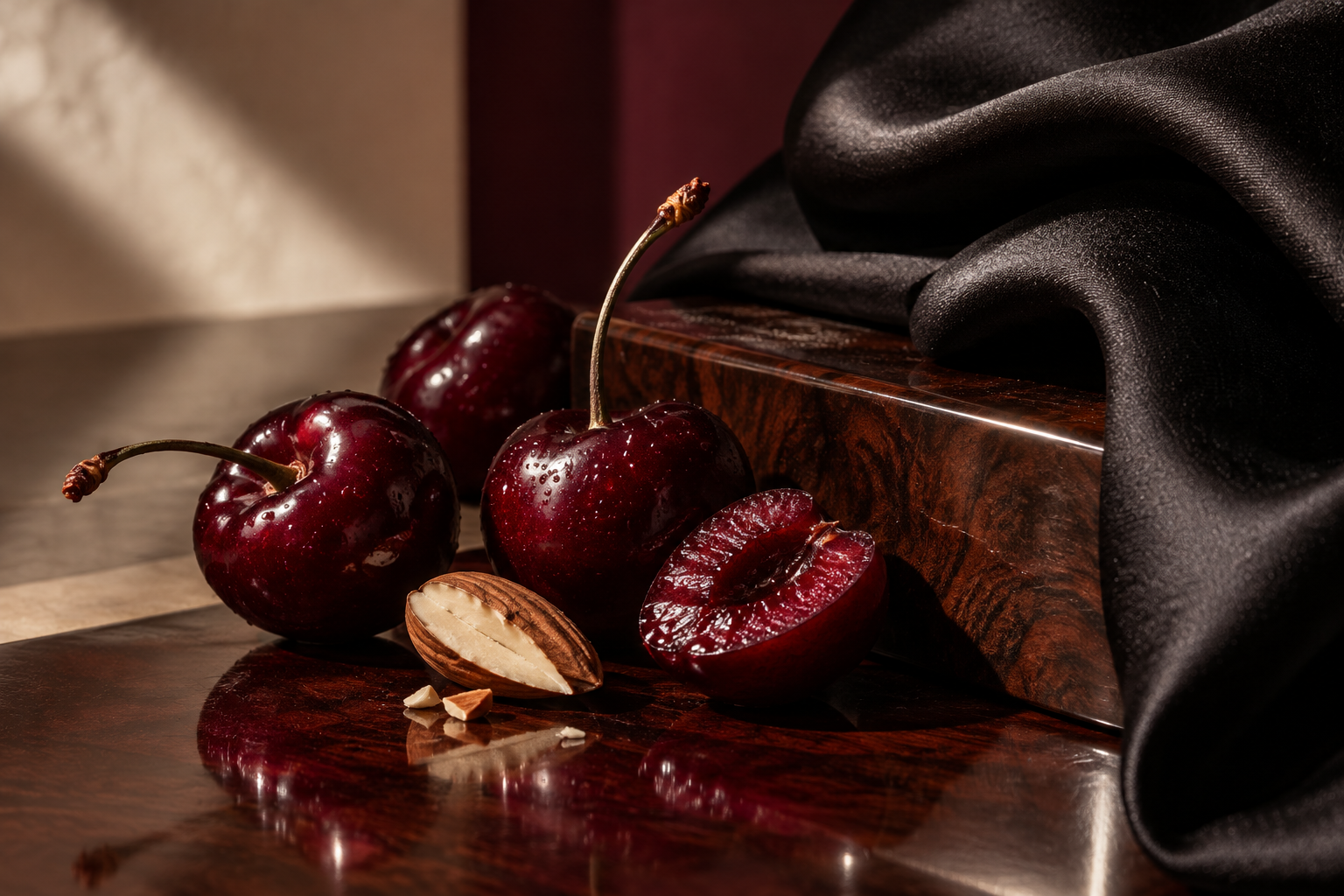
I like a cherry perfume with a little bitterness left in it. The fruit can be extravagant. Give it an almond edge, a dry piece of wood, something faintly smoky, and I begin to pay attention.
There is a particular red I have in mind: dark enamel on a small piece of jewelry, almost black until it catches the light. Cherry can carry that kind of color in perfume. It can also be gloriously sticky. I would be sorry to lose either possibility, although I know which end of the counter draws me first.
The smoke. And then, rather unexpectedly, a flower.
Cherry Smoke has a distracting detail
The name of Tom Ford Cherry Smoke Eau de Parfum practically dims the lights before the perfume has entered the room. Dark cherry, smoked woods, olibanum, saffron: a fairly theatrical company. Yet osmanthus is the detail that keeps interrupting my reading of the description.
Tom Ford gives that flower apricot, olive and leather facets. Apricot I can place immediately beside cherry. Olive makes me pause. It is such a specific, slightly awkward word to discover among all the polished seduction. Good. A fragrance description occasionally needs something that resists becoming a mood board.
Those facets belong to the house’s account of osmanthus; they are not a promise that every wearer will identify three separate smells. Still, they change the idea of the composition. The flower is doing more than softening a dark setting. It gives the fruit another route into it, through a fleshy, almost tactile association rather than sweetness alone.
I imagine a lacquered red object on a table that has been rubbed smooth with use. No velvet curtain required. There is already enough drama in the meeting of something bright and something worn.
That is the question Cherry Smoke leaves me with: can the cherry remain a recognizable presence when the woods and incense gather around it? I want the interruption, the dry edge. I also want the fruit. Turning everything dark would be an oddly unimaginative thing to do with such a vivid subject.
Almond changes the color; jasmine changes the subject
Tom Ford Lost Cherry Eau de Parfum begins from a more lavish idea: black cherry and cherry liqueur with bitter almond. Rose, jasmine, Peru balsam, roasted tonka and woods give that fruit a very full setting.
The almond is where my attention settles. There is a small, delicious confusion between fruit and pastry in the idea of it. A cherry drawn with an almond line around it seems a little less innocent, even before the liqueur arrives. This is also where the language of bitterness becomes slippery. A bitter-almond note does not tell us that the finished perfume will feel dry. Balsam and tonka have their own say in the arrangement.
I like the almost excessive hospitality of the description. The fruit has been offered flowers, a drink, somewhere warm to sit. Lost Cherry gives a useful reference for the reader whose pleasure lies in that generosity; Cherry Smoke puts the same broad subject in a room with more grain and shadow. The distinction concerns the setting as much as the cherry itself.
Then Tom Ford Electric Cherry Eau de Parfum sends in Morello cherry, ginger, jasmine sambac and musk, and the heavy furniture can go.
Jasmine matters here. It is tempting to line up three names from the same cherry collection and imagine a simple scale from light to dark, but the flowers complicate that pleasant little system. Electric Cherry is presented by the house as a floral fruity perfume. The ginger and jasmine give the fruit a different kind of company from almond, balsam or incense. It deserves to be considered as a whole floral composition, rather than a reduced serving of Lost Cherry.
Someone can love cherry and dislike the jasmine direction. Someone else may discover that the jasmine was the point all along. That possibility interests me more than deciding which of the three is the most serious. Perfume is quite capable of being serious about pleasure.
The powder is part of the attraction
A polished fruit and a powdered red lip share a color without sharing a surface. That is the change I think about with BDK Rouge Smoking Eau de Parfum. Cherry accord and pink berries lead towards black vanilla and heliotrope; tonka and white musk are among the base notes. BDK also places the fragrance in the atmosphere of Pigalle, its Parisian nights and red light.
A large invitation, for something that begins with a cherry. I am more taken with the powder than with the promise of a whole night out. Powder can make a fruit seem dressed, its glossy outline softened without being erased. The vanilla and heliotrope give us something more particular to consider than another declaration of dark sweetness.
Rouge Smoking also loosens the link between a perfume’s name and the most literal image it suggests. After Cherry Smoke, it would be easy to keep thinking about burning wood. Here I would shift attention towards vanilla, musk and the powdered effect described by the house. Similar words on labels can lead the imagination into quite different rooms.
Keep the Eau de Parfum name attached to this comparison. Rouge Smoking Extrait is a separately composed version. Its existence does not turn the Eau de Parfum into an unfinished sketch; nor should a review of one be carried over to the other. I dislike discovering at checkout that the perfume under discussion has quietly changed identity.
A little praline, and then a great many flowers
KAYALI’s Lovefest Burning Cherry | 48 puts black cherry and raspberry beside praline, palo santo, guaiac wood and patchouli. Praline gets straight to the point. I like that.
The woods are what keep this description from collapsing into a confectionery label. I am curious about the meeting of something nutty and indulgent with the woody, earthy direction beneath it. A warm perfume can have edges. In fact, the edges may be what makes all that warmth enjoyable.
Set Lovefest conceptually beside Rouge Smoking and the difference becomes useful: praline with woods and patchouli on one side, black vanilla with heliotrope and musk on the other. Both may appeal to a sweet tooth. They are offering different surfaces to it. Calling everything gourmand does very little of the choosing for us.
Snif Tart Deco Eau de Parfum supplies another diversion. Black cherry and raspberry are there, but so are rose, jasmine and mimosa, followed by birchwood, vetiver and vanilla. By this point the flower shop has almost as much stock as the fruit stall.
I find that abundance appealing. Mimosa in particular pulls my imagination away from a neat red cherry on a stem and towards something more diffuse. The name may make tartness the first expectation; the published floral and woody notes suggest a longer acquaintance than that one bright adjective allows.
A cherry opening can be the invitation to a perfume whose later flowers matter much more to you. There is no disappointment in that. The mistake would be to keep searching for the fruit you expected while overlooking the composition you actually enjoy. Tart Deco makes a useful floral and woody point of comparison with Electric Cherry: two ways for the fruit to admit other interests, with different flowers around it.
Six cherry perfumes, kept distinct
Here are the main differences gathered in one place. This is a map of the published descriptions, with room left for the perfumes to behave like perfumes when you wear them.
| Fragrance | Published notes that shape the comparison | Style to explore | The deciding question |
|---|---|---|---|
| Tom Ford Lost Cherry Eau de Parfum | Black cherry, bitter almond, rose, Peru balsam, roasted tonka | Liqueur-like and almond-accented | Do you enjoy the richness around the fruit? |
| Tom Ford Electric Cherry Eau de Parfum | Morello cherry, ginger, jasmine sambac, musk | Bright fruit with white flowers | Does the floral character suit your idea of cherry? |
| Tom Ford Cherry Smoke Eau de Parfum | Dark cherry, smoked woods, olibanum, osmanthus | Smoky and shadowed | How much smoke do you want beside the sweetness? |
| KAYALI Lovefest Burning Cherry | 48 | Black cherry, raspberry, praline, palo santo, guaiac wood, patchouli | Gourmand fruit with a woody backdrop | Do you prefer praline warmth or a drier finish? |
| Snif Tart Deco Eau de Parfum | Black cherry, raspberry, rose, jasmine, birchwood, vetiver, vanilla | Fruity floral with a woody frame | Does the fruity opening lead to a base you love? |
| BDK Parfums Rouge Smoking Eau de Parfum | Cherry accord, pink berries, black vanilla, heliotrope, tonka, white musk | Powdery, vanilla-accented cherry | Do you enjoy a soft, powdered texture? |
There is no bowl of cherries inside a note list
A cherry note usually names a constructed aromatic impression. It can suggest fresh flesh, preserve, almond or liqueur. The list tells you what the perfumer wants to evoke; it does not disclose the proportions of the formula, the sweetness you will perceive or the whole sequence of the fragrance on your skin.
This is why an almond accent and an almost syrupy setting can coexist. It is also why adding up the sweet-sounding words is a poor way to predict the result. Rose can become the part that holds your attention. A dry wood may give shape to a very rich center. The notes have relationships, and relationships tend to spoil arithmetic.
The same cherry can send one imagination towards a bowl of fruit and another straight to a cough sweet. Or marzipan. I find that small detour fascinating: the fruit has scarcely arrived before someone has given it a childhood cupboard or a pastry counter. The association can be delicious, unwelcome or simply hard to shake. Wanting less of it is a more precise wish than wanting a less sweet perfume.
There is a reason almond and cherry keep borrowing each other’s vocabulary. The American Chemical Society describes benzaldehyde’s odor in terms of bitter almonds and cherries. One odorant can belong to both descriptions. That helps explain the proximity; it does not supply the recipes for these six perfumes, and a note list cannot tell us which materials produced a particular association.
Lost Cherry makes the almond-and-liqueur invitation explicit. If marzipan is exactly the pleasure you want, that invitation is worth noticing. If the medicinal or confectionery association is what you hope to leave behind, pay attention to the surrounding story: Electric Cherry’s ginger and jasmine, or Cherry Smoke’s woods and incense. Neither description can promise what your own nose will remember. They do, however, give the cherry somewhere else to go.
Cherry blossom needs its own introduction. It names a floral idea, whereas the dark fruit in this selection points elsewhere. Sharing a tree does not make the fragrances interchangeable. The same applies to red packaging, although I understand its powers of persuasion perfectly.
For another kind of fruit, the blackcurrant perfume guide is a useful neighboring conversation: green, tart, juicy and liqueur-like are more helpful distinctions than simply deciding that fruit is sweet. I would keep that vocabulary close to hand. It leaves the fruit some dignity.
Find out what you are really choosing
Perhaps it is cherry you want. Perhaps it is almond, or the soft powder around it. Vanilla appears often enough in this selection to deserve a moment of suspicion: if it is the part you keep loving, our guide to vanilla perfumes for women by scent style may explain more about your taste than another bottle with a red label.
I would begin a practical comparison with two clearly different arrangements, such as the almond and balsamic direction of Lost Cherry against Cherry Smoke, or the flowers of Electric Cherry against Rouge Smoking’s vanilla and powder. Wear each alone first. On a separate comparison day, use similar small amounts and keep body products neutral. A scented lotion is perfectly entitled to be lovely; it is unhelpful as an unannounced seventh fragrance.
Leave a few concrete words beside each sample. Lovely almond. Wanted the fruit to stay. Too much powder after the opening. Those notes will be worth more later than a row of enthusiastic stars. The guide to perfume samples for women takes the practical details further.
The favorite still needs an ordinary day: a desk, lunch, the journey home, other people within conversational distance. Notice what remains attractive once the first bright recognition has passed. Application may need adjusting to that setting, and the best opening need not belong to the perfume you want beside you for hours.
I keep coming back to the almond and the unexpected flower. Somewhere in the search for a dark cherry, osmanthus has managed to make itself indispensable to the conversation. Quite an entrance, for a flower whose name was absent from the bottle.
