



Oakmoss has a particular talent for making an otherwise lovely perfume a little less agreeable. A bright flower acquires a shadow. Citrus takes on a dry, almost bitter edge. Sometimes the effect is as subtle as a green seam in a beautifully cut coat; sometimes it changes the whole character of the fragrance. I have always found that tension more interesting than the familiar promise of a perfume that is simply fresh, feminine and elegant.
The name is deceptive, for a start. Oakmoss is a lichen, not the soft green moss covering stones in a garden. And a perfume described as mossy need not contain an identifiable oakmoss extract. The distinction is worth learning before choosing anything, because chypre, moss accord and oakmoss itself are three different ideas. One is a family of perfume compositions; one is an olfactory impression; one is a raw material that may or may not be part of the formula.
There is a reason this material appears in conversations about classics such as Guerlain Mitsouko and Chanel N°19, yet has not disappeared from newer work. The difference from Chanel N°5 is also worth noticing: N°19 makes its green galbanum and powdery iris central to its identity, an entirely different artistic decision within the same house. Dior gives a rosy chypre a cool, mossy edge. Ormonde Jayne turns the lichen into a contemporary floral composition. Andrea Maack takes a darker road, with galbanum, cedar and an almost uncanny green atmosphere. These are not interchangeable bottles. The differences are the pleasure.
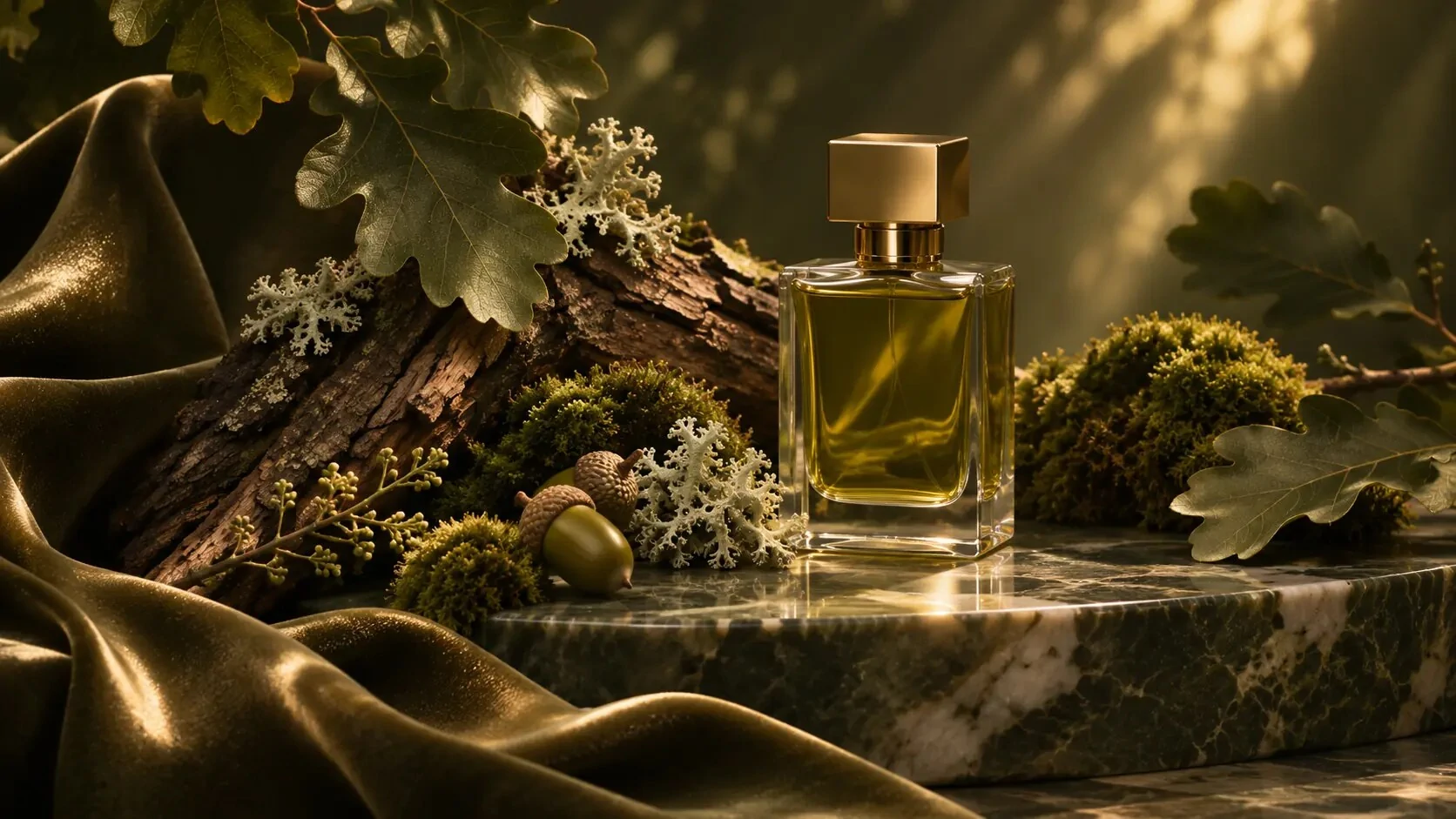
First, what is oakmoss?
Oakmoss, a Mossy Accord and Chypre Are Different Things
Oakmoss is a lichen used to produce aromatic perfumery extracts. A mossy accord is a composed scent effect. Chypre describes a fragrance structure in which bright, floral and darker elements meet. Keeping those three ideas separate makes an oakmoss perfume much easier to choose: an ingredient, an impression and a whole composition answer different questions.
The material itself has more range than the familiar image of a damp forest. IFF’s oakmoss absolute comes from Evernia prunastri and is described with mossy, leathery, balsamic and earthy facets, alongside smoky and marine nuances. I enjoy the tension in that description. A smell can suggest cool ground and something warmer, almost leathery, without settling into either picture completely.
Tree moss is a neighboring material, not simply oakmoss given a different color. IFF lists a separate tree-moss extract, with a warmer, resinous character reminiscent of fir balsam. The distinction is useful when a description becomes loose with names: a material’s identity is more informative than calling it green, brown or natural.
A perfumer can also work with a mossy aromatic material such as Veramoss, which IFF describes through oakmoss, soft wood and earthy facets. That is a different tool from a lichen extract. In a finished fragrance, the interest lies in what the tools accomplish together. I would not dismiss an elegant mossy composition because its forest impression was composed rather than literally gathered.
Oakmoss is usually harvested from lichen growing on trees, rather than from a carpet of ground moss. Commercial perfumery materials vary with source and processing. The point of knowing this is practical as well as botanical: an oil or absolute is not the same thing as a moss note on a marketing page, and a mossy scent isn’t automatically evidence that one specific extract was added to the final bottle.
What makes a mossy note attractive?
Think of the relationship between a flower and the earth beneath it. The flower attracts attention; the earth rarely asks to be noticed, yet it changes the entire scene. That is one possible role for oakmoss in perfumery. In another composition the mossy effect becomes quite assertive, almost inky, with leather, smoke or bitter greenery crowding out the conventional prettiness of a floral heart.
It is a welcome alternative to the idea that every perfume ought to become sweeter as it develops. A chypre can begin with familiar citrus and arrive somewhere cooler, drier, more mysterious. The beauty is often in the friction between its bright entrance and its shadowed base. If an overtly sugary trail leaves you cold, that is a good reason to explore this family. The dry material can give a perfume shape without turning it into a stern exercise in natural ingredients.
How a chypre differs from an oakmoss perfume
The word chypre comes from the French name for Cyprus. François Coty’s Chypre, introduced in 1917, did much to establish the modern family in fashionable perfumery. Its classical structure places bright citrus, often bergamot, against flowers and a deeper mossy foundation, historically with ingredients such as oakmoss, patchouli and labdanum. But chypre is a way of organizing a perfume, not the name of a single ingredient.
It follows that a perfume may be recognizably chypre without repeating a 1917 recipe. Designers can create a mossy or dry green accord with several materials, including patchouli, vetiver, labdanum or aromatic molecules developed for that purpose. In our guide to patchouli, that material gets its own exploration. Here it is one piece in a wider composition, never a license to call every patchouli perfume oakmoss-based.
That difference also explains why the old division between a feminine floral and a masculine green fragrance feels inadequate. Compare the sharp green-and-iris personality of Chanel N°19 with the rose, spice and mossy architecture of Sisley Eau du Soir, then with the modern floral abundance of Le Labo Ylang 49. All can speak the language of chypre, yet none belongs inside the same narrow label. The most useful comparison is not who can wear them, but how each composer handles light and shadow.
Why oakmoss perfumes changed over time
Natural oakmoss contains constituents capable of causing skin sensitization. The history of the ingredient has therefore been shaped by both perfume artistry and safety requirements. In the European Union, atranol and chloroatranol are prohibited in cosmetic products; industry standards also regulate oakmoss and treemoss extracts according to intended use. Purified, low-atranol qualities and other aromatic materials give perfumers different ways of composing a convincing mossy effect.
This history helps explain why a contemporary bottle of an old perfume may not smell identical to a vintage one, even when the name and the design are familiar. Formulations and materials can change, and memory rarely measures their differences fairly. Guerlain Mitsouko is a fascinating case because it has lived through those changes. Still, the appropriate object of a buying decision today is the specific edition that is sold today.
There is an easy mistake at the opposite extreme: assuming a perfume that uses modern ingredients must be artistically inferior to a formula full of raw lichen. That misses the point of perfumery. In the hands of a thoughtful perfumer, a composed mossy accord can be a beautiful tool, just as an extracted lichen can be. The question worth asking is what the resulting perfume does, not whether its ingredient list satisfies a romantic picture of the forest.
The classics: green structure with character
Classic chypres were never designed to be polite floral waters. They tend to have an architecture: the beginning feels bright, the heart brings flowers or fruit into view, and then a darker foundation gives the composition a different kind of grace. Some are famously direct. Others are surprisingly elusive.
Reading the Green Impression in Chanel N°19
Chanel N°19 shows why identifying one material is only the beginning. For the current Eau de Parfum, Chanel emphasizes green galbanum and powdery iris, with a floral dimension that includes rose. Its published ingredient list also names oakmoss extract. The extract and the overall green impression are connected, but they are not the same description.
That gives us a more interesting way to approach it than asking whether it smells sufficiently of moss. Follow the sharp green impression, then the powder and flowers, and notice how the darker foundation changes their character. I am drawn to that refusal to make every detail soft and agreeable. Green can be poised, even a little severe; it does not have to imitate a garden.
Someone who enjoys the forest-like side may want a more overtly mossy comparison. Someone fascinated by the contrast with iris may already have found the important part. The useful discovery is not a correct answer on a note-identification test. It is knowing which relationship you would like to keep wearing.
Guerlain Mitsouko Eau de Parfum: peach with an unexpected darkness
Guerlain Mitsouko is one of the most beguiling arguments for keeping a little mystery in a perfume. Jacques Guerlain introduced it in 1919 and did something that still feels audacious: he allowed the juicy, almost velvety idea of peach to meet the dark structure of a chypre. The house’s present description combines peach, jasmine and rose centifolia, while spicy notes and impressions of undergrowth and vetiver deepen the base. You can read that description without ever needing to pretend that the modern formula contains precisely the same proportions as the original.
Peach is rarely treated as a severe perfume note, and that is what interests me. Set against flowers alone, it may sound plush and sunny. Place it above a darker foundation and it suddenly has a different kind of beauty, more ambiguous and more adult. In our article on peach perfumes, the fruit travels through several moods; in Mitsouko, its historical pairing with a chypre structure is what gives the story its tension. You begin with something unmistakably inviting and are asked to follow it somewhere less predictable.
The house’s current Mitsouko Eau de Parfum is the specific edition considered here. Guerlain’s description is excellent evidence for the peach, rose, jasmine and woodland character; it should not be stretched into a precise declaration of every moss extract used in every current batch. The Perfume Society discusses Mitsouko in the history of oakmoss reformulation, which gives this perfume a particularly instructive place in the story. Of the classic choices, it is the one I would put beside a modern floral chypre to hear how fruit changes the mood of an entire composition.
Clinique Aromatics Elixir: a floral chypre that refuses to whisper
Clinique Aromatics Elixir Eau de Parfum has a directness that many contemporary florals have politely misplaced. The maker lists Bulgarian rose and orange blossom, then jasmine and ylang-ylang, but it is the base of patchouli and oakmoss that gives those flowers their formidable character. They have roots, and they seem quite determined not to conceal them. The perfume belongs to the floral-chypre tradition, where richness is part of the pleasure, and an earthly undertone is an active participant rather than a delicate background effect.
Set it beside the almost dry, icy green impression of Chanel N°19 and the difference is dramatic. Chanel allows iris and galbanum to give the composition a sharp outline; Aromatics Elixir makes room for a fuller bouquet with more depth beneath it. Someone who usually enjoys airy feminine scents may find the Clinique disconcertingly serious. I can understand why that very seriousness attracts devoted wearers. The point is not to prove which fragrance is stronger. It is that a floral perfume can be lush and dark at once, and some beautiful things have no interest in being discreet.
Estée Lauder Knowing: the dark foundation of a luminous bouquet
Plum. That is the small detail that changes the mood of Estée Lauder Knowing Eau de Parfum. The house places it beside rose, tuberose, mimosa and pittosporum, before a heart of jasmine, patchouli and orange flower gives way to oakmoss, vetiver, sandalwood and amber. There is almost enough material for two perfumes, yet the published composition has a coherent idea: a broad, confident bouquet supported by a shadowed, woody foundation.
The plum is interesting because it changes the meaning of the flowers. Rose and tuberose might have been simply opulent; a hint of fruit makes their warmth less predictable. And the darker notes return that richness to the earth. This perfume has little in common with a translucent floral designed to vanish into clean skin. It asks for attention to the shape of the whole arrangement.
Estée Lauder attributes the inspiration for the scent to Evelyn Lauder, who noticed pittosporum on a trip to the south of France. The company’s own story gives the floral heart an identity beyond a standard list of fashionable notes. Pittosporum is rarely the first flower that enters a conversation about luxury perfume, which gives Knowing an extra point of interest. The floral heart feels like an idea the house genuinely wanted to explore.
There is a lovely distance between Knowing and Mitsouko. Both use fruit above darker foundations, but Mitsouko’s peach is held in the strange, beautiful geometry of an old chypre, while Knowing seems to gather its plum and many flowers into a more expansive presence. I would not choose between them by assigning one to daylight and another to evening. The decision is simpler and more personal: are you drawn to the mysterious contour of one composition, or the abundant floral confidence of the other?
Sisley Eau du Soir: a chypre with remarkable composure
Sisley Eau du Soir is composed around a fine balance of citrus, flowers and a classically mossy foundation. Its notes begin with mandarin, grapefruit and pepper. Seringa, jasmine, rose, ylang-ylang, lily of the valley and iris make an elaborate heart; musk, amber, oakmoss, patchouli and cistus lend it darker depth. This is a more floral and expansive composition than the bare phrase ‘earthy oakmoss’ might lead you to expect.
I especially like the presence of seringa, the shrub whose blossoms are sometimes called mock orange. It brings a particular garden association into a densely arranged perfume, another reminder that a sophisticated composition isn’t obliged to hide every trace of an ordinary plant. Eau du Soir is polished, yes, but the green and mossy foundation keeps that polish from becoming empty. The citrus has somewhere to go; the flowers meet a base strong enough to challenge them.
Its packaging has long had an artistic identity of its own: the sculptural stopper was designed by Bronislaw Krzysztof. A bottle can be decorative without making the perfume inside trivial. Eau du Soir makes a persuasive case for a formal floral chypre that remains interesting past its first graceful impression. Compared with Chanel N°19, it is much more abundant in flowers; the Chanel feels sharper and more spare. Both reveal how a mossy base can support something unmistakably feminine without turning sugary.

When the moss moves into the modern wardrobe
A modern chypre need not reproduce the dense, sometimes almost antique impression of a famous early formula. There are new ways to use a mossy note, including compositions that build around contemporary floral materials, carefully restrained accords and unfamiliar combinations of texture. The best of them have the courage to differ from the classics instead of selling a vague idea of heritage. Here I want to listen for the relationship between the dark note and everything above it, not for a claim that the bottle is simultaneously timeless, versatile and perfect for every occasion.
Dior Gris Dior: a gray with several colors inside it
Gris Dior Eau de Parfum belongs to the house’s La Collection Privée, and the name reveals something about its ambitions. A shade of gray can be an exercise in nuance; here Dior translates that idea into a chypre built from citrus, rose, violet and oakmoss. The brand’s current ingredient list also includes Evernia prunastri extract. That makes Gris Dior especially useful in this article: its mossy language is not merely a careless guess inspired by a woodland photograph.
Of all the modern interpretations, this one has a particularly natural connection to fashion. I see something in it of a gray wool coat with an unexpected lining, although the analogy only matters because the perfume itself has an equally interesting relationship between surface and depth. Rose and violet are familiar, decorative subjects. Oakmoss changes the temperature of the entire idea. It introduces shadow and structure into a composition that might otherwise feel like an elegant floral abstraction.
Gris Dior also lets us distinguish two questions that are often muddled. Does the perfume name a mossy note? The maker does. Does the current formula list an oakmoss extract? In the checked US edition, it does. Neither detail tells us precisely how long it will last on one person’s skin, nor how a particular wearer will interpret its subtlety. The more worthwhile comparison is with Sisley’s fuller floral chypre or Chanel’s greener sharpness. There is no single way to make an intelligent perfume around moss.
Le Labo Ylang 49: flowers refusing to stay soft
Le Labo’s Ylang 49 begins in quite another place. The maker calls it a chypre floral, with ylang-ylang and a Tahitian gardenia accord, then brings in patchouli, oakmoss, vetiver, sandalwood and benzoin. It sounds like a collision between a lush bouquet and the darker materials that normally give a perfume its backbone. That is precisely the attraction. One needn’t choose between a voluptuous floral fragrance and something dry, woody and a little unruly.
Ylang-ylang has a generosity of its own. It is not the shy sort of flower that disappears politely whenever a base note arrives. Give it sandalwood and benzoin, then oakmoss and patchouli, and the composition becomes a much more complicated affair than a tender floral veil. I am fascinated by the possibility that the sensual part of a perfume might come from friction rather than sweetness. A strong flower can meet a strong base and neither has to yield.
This is also a good place to remember that a note pyramid is a description, not a laboratory report. Le Labo’s published ingredients and its advertised notes answer different questions. A perfume can build the impression of a mossy accord from more than one tool. When I compare Ylang 49 with Dior Gris Dior, what matters artistically is the temperature of their floral heart: Gris Dior seems to move through restrained shades, while Ylang 49 embraces the density of a bouquet before making it darker.
Papillon Dryad: a green perfume that keeps changing seasons
Papillon Dryad makes the forest association much more literal, and quite deliberately so. The perfumer lists narcissus, oakmoss, jonquil, cedrat, galbanum, benzoin and vetiver. Papillon’s own story imagines the turning of seasons among trees. The result is a compelling set of contrasts even on paper: luminous flowers and citrus, sharp green galbanum, then earthy moss and deeper resins. Here the woodland language belongs to the perfumer’s stated inspiration rather than being pasted onto a random green perfume by an enthusiastic copywriter.
Narcissus can be stranger and more characterful than the word ‘floral’ prepares us for. Its presence, together with jonquil and galbanum, gives Dryad a botanical personality quite different from the more conventionally elegant Eau du Soir. I like a perfume that can be beautiful without trying to be tidy. There is room for the sense of a wild garden, a dry leaf, a flower whose scent is almost too strong, and an earthy base that refuses to scrub the scene clean.
Dryad is a valuable niche counterpoint to the grand classics. Someone who loves Chanel N°19 for its sharpness may be intrigued by the same general green appetite here, yet Dryad doesn’t have to borrow Chanel’s famous iris signature. It stands on its own blend of narcissus, galbanum, moss and vetiver. The maker lists specific bottle and sample formats, but those are secondary to the reason for trying it: an imaginative treatment of the chypre family that never forgets the actual plants.
Ormonde Jayne Evernia: bringing oakmoss into focus
There is a particular intelligence in naming a perfume after the lichen itself. Ormonde Jayne Evernia places oakmoss prominently in the base alongside cashmeran, sandalwood, musk, opoponax and Iso E Super, while the opening offers cassis, bergamot, cardamom, pink pepper and coriander. A substantial floral heart with orris, freesia, violet, jasmine, lily of the valley and Moroccan rose sits between them. This is an unusually generous way of making an earthy note feel sophisticated without losing its identity.
Cassis is the small surprise. A blackcurrant accent can make a perfume feel sparkling or distinctly tart, and its presence over the warmer base gives Evernia more personality than another predictable green floral. Orris and violet add texture, the woods bring a softer foundation, and the oakmoss serves as a recognizable center of gravity. Nothing about this arrangement requires the wearer to love an aggressively bitter drydown. The lichen has become part of a composed, contemporary luxury perfume.
Founder Linda Pilkington’s account of receiving and smelling a new oakmoss sample belongs to the brand’s own published story. It is a concrete reminder that modern formulations can work with carefully prepared materials. It is also a good model for factual attribution: that was her experience, not the experience of the IRFĒ editor. What we can do is read the perfume closely, compare it with the source material and find out why the composition deserves attention.
A different kind of moss: intimacy, leather and green strangeness
Oakmoss does not always live in an elaborate floral chypre. There are compositions that make it quiet and intimate; others give it a more unsettling edge, with woods, leather or even a suggestion of the uncanny. That variety is the reason to keep looking beyond the most famous houses. With modern perfumes, the mossy effect may be central or almost hidden in a larger texture. There is no need to force them into the same ‘best overall’ category to appreciate their differences.
Miller Harris L’Air de Rien: the perfume of a lived-in room
There is nothing particularly ceremonial about Miller Harris L’Air de Rien Eau de Parfum. Created by Lyn Harris for Jane Birkin and released in 2006, the fragrance gathers neroli, oakmoss, patchouli, amber, musk and vanilla into something the house describes with remarkable intimacy. Old books, familiar rooms and the traces of a person’s presence belong to the original brief. The name, translated roughly as the air of nothing, is one of those charming contradictions: it describes a room that is full of small, unspoken things. The moss and patchouli suggest old paper and shaded wood; amber and musk make the atmosphere warmer and closer.
What stays with me is the difference between private memory and public elegance. Sisley Eau du Soir seems perfectly capable of entering a grand room and looking at ease; L’Air de Rien is much happier in the room someone has just left, among the books and objects that hold their personality. There is a kinship with musky fragrances, but this one has a dry and earthy undertone that changes the whole mood. Miller Harris says it is produced in limited annual batches, so the exact current availability deserves a check. I would rather have that clear distinction than pretend every romantic historical fragrance is sitting in the same shop window.
Andrea Maack Coven: the strange pleasure of a dark green scent
Then there is Andrea Maack Coven Eau de Parfum, whose published note pyramid seems designed to unsettle a tidy perfume classification. Vanilla, labdanum and whiskey lead into cedarwood and oakmoss, while galbanum and clove give the structure a sharp, green and spicy edge. The brand identifies perfumer Céline Ripert. On paper alone, this arrangement moves from unexpected warmth into something dry, almost theatrical. Oakmoss appears in the heart rather than being confined to the familiar picture of a forest floor at the very bottom of a composition.
Galbanum makes the difference. Its green bitterness can be startling beside warmer materials, and the contrast keeps Coven from becoming another generic woody fragrance. In the cedarwood family, a dry wooden structure is often the central attraction; here it is only part of a more restless dialogue with moss, labdanum and spice. The atmosphere is unusually forceful even in the published composition. It is the relationship the maker has chosen that earns Coven a place here. Coven will appeal to someone attracted by green strangeness, not necessarily to the person who wants a graceful floral chypre for a quiet afternoon.
Goldfield & Banks Purple Suede: leather, lavender and an oakmoss trace
The title Purple Suede suggests texture before scent. Goldfield & Banks describes Tasmanian lavender joined by rose, a wood-and-leather accord, patchouli, civet and Australian agarwood. Pink pepper and bergamot open the composition. Oakmoss does not dominate the official note pyramid, yet the current published ingredient list names Evernia prunastri extract. This is an excellent case study in why the advertised centerpiece and a material present in the formula are not always the same thing.
I would choose Purple Suede for someone intrigued by the idea of moss adding a dry contour to leather and flowers. Lavender can be pleasantly clean, even familiar; leather changes its character. The green shade of oakmoss seems a natural part of this world, but the creative focus is unmistakably lavender and leather. That difference should remain clear to a reader. We are exploring the range of moss in perfumery, not pretending every listed bottle was composed to smell like a lichen sample.
The perfumer is Ilias Ermenidis, and the maker speaks openly about the design’s Australian botanical references. These are concrete facts; a sales phrase like ‘incredible longevity’ would say far less. In our guides to lavender perfumes and sandalwood for women, the interest is likewise in how a familiar material changes when paired with unexpected companions. Purple Suede belongs here for its distinctive balance of aromatic floral, leather and woody depth, not because somebody assigned it a copied numerical rating.
How these three take different paths
L’Air de Rien invites the wearer close; Coven draws a theatrical green darkness; Purple Suede wraps an aromatic floral in leather. They should not be explained as three versions of the same oakmoss perfume. Even the placement of the material differs: Miller Harris names oakmoss as part of the heart, Andrea Maack names it with cedarwood, and Goldfield & Banks lists the extract in the ingredients while foregrounding lavender, rose and woodleather in its note story.
That variety matters for a gift, too. A person who loves intimate, warm fragrances may appreciate the atmosphere of L’Air de Rien but find Coven’s galbanum too sharp. Someone who likes leather can be fascinated by Purple Suede without wishing to wear a classical peach chypre. The terms ‘mossy,’ ‘woody’ and ‘green’ cover a large range of artistic choices. Someone drawn to green tea perfumes may enjoy the fresh, shaded end of this family before moving into the more demanding chypres. You need the actual composition to understand what each one means.
How to find your place among mossy perfumes
There is a simple way to make this rather large family feel manageable. Forget the idea of a universal winner and notice what sort of darkness you enjoy. Do you want a brisk, sharp green impression against iris? Chanel N°19 is a natural place to begin. If fruit interests you, the peach above Mitsouko’s shaded base is a more revealing experiment. An abundant floral composition with firm moss and patchouli underneath leads to Clinique Aromatics Elixir or Sisley Eau du Soir. None of these has to be ‘the best overall’ to be worthy of your attention.
Modern choices bring different pleasures. Evernia is interested in the lichen itself and the way it can sit beneath delicate flowers. Dryad is more unruly, full of green growth and narcissus. Gris Dior gives the chypre structure a deliberate fashion-house restraint; Ylang 49 lets flowers become almost defiant against the darker base. The person who likes leather or a worn, intimate atmosphere will find something altogether different in Purple Suede or L’Air de Rien.
There is also a reason to sample beyond the traditionally feminine section of a perfume counter. A composition advertised for men may use moss as elegantly as any bottle marketed to women. The men’s cologne family includes dry woods and fougères that share part of this tradition, while our wider guide to women’s perfume houses provides a different route into the same subject. Marketing categories are useful as shop signs, not as final verdicts about a fragrance’s character.
What the note list can tell you, and what it cannot
Many fragrances use the word ‘moss’ as part of a creative accord. That is not automatically an ingredient declaration. Some makers list an oakmoss extract in their current ingredients, as Chanel does for the checked N°19 Eau de Parfum and Dior does for Gris Dior. Others describe oakmoss in the note structure while the proprietary formula remains undisclosed. This isn’t necessarily deceptive. Perfumery has always involved both real materials and artistic descriptions of how a composition smells.
Look at a bottle’s current formulation and exact concentration when a detail matters to you. A fragrance house may sell Eau de Parfum, Eau de Toilette and parfum as separate products. You cannot assume the same notes, ingredient disclosures or sensory balance simply because the names are related. Nor can a concentration label reliably tell you whether the perfume will project more strongly or last a precise number of hours on your skin. A close-to-skin mossy fragrance may be more personal than a powerful floral trail; intensity and longevity are not the same thing.
If you enjoy the restrained side of a chypre, a sample can be more revealing than a rating. Begin with a scent strip to distinguish two radically different compositions, then give a chosen candidate time on skin if that is how you normally judge perfumes. A quick opening alone tells little about the darker notes that make the family distinctive. There is no need to turn the process into laboratory work. In fact, the quiet changes over time are often what make a perfume worth discussing after the bottle has been put away.
What about skin sensitivity?
Natural fragrance materials are not automatically kinder to sensitive skin than composed accords. Oakmoss extracts are among the fragrance substances that have required particular attention because of sensitization concerns. Restrictions on atranol and chloroatranol and the availability of specially processed extracts have changed how the ingredient can be used. That history is important, but it does not make the word ‘modern’ or ‘IFRA-compliant’ a personal guarantee that a particular perfume will suit everyone.
The US Food and Drug Administration explains that fragrance ingredients, including those of plant origin, can cause sensitivities and that consumers should consult the product’s actual ingredient information. If you have a known fragrance allergy, choose using your specific circumstances and the current label, not an article’s general description of what smells gentle. A maker’s claim of being ‘natural,’ ‘clean’ or ‘paraben-free’ answers a different question. Our guide to clean perfume brands examines some of that terminology separately.
For an informed shopper, the issue is not a contest between nature and chemistry. Traditional extracts and carefully built modern materials both belong to perfumery. What matters is the exact product, its compliance with applicable requirements and how it works for the individual. The drama of a mossy note should remain in the art of the composition, not in ungrounded assurances about skin safety or mysterious ingredients.
A gift, an evening scent, or simply something worth owning?
A green chypre can be delightful in daylight. A richly floral mossy perfume may be wonderful at dinner, and a darker, leather-inflected composition might be precisely right for someone who already lives in woody fragrances. These are ideas to explore, not a timetable. I have never thought a perfume deserved to be confined to an evening simply because its base is serious. Some people find mossy scents wonderfully refreshing in hot weather; others prefer them when the air is cooler. Taste has its own calendar.
A gift is a trickier matter. Someone who happily wears citrus and soft flowers may not welcome the dark chypre you have fallen in love with. You can explore our fragrance gift ideas, but the most generous gesture is often a discovery format or an opportunity to choose. And before buying perfume online, check which edition is pictured, whether a listed bottle is still current, and whether the shop’s return rules apply to an opened fragrance. Famous historical perfumes are particularly easy to confuse with their vintage versions.
In a broader selection of beautiful perfumes for women, a mossy chypre may occupy just one corner. That is fine. It does not need to become everyone’s signature. It only has to reward the particular person who loves what it does: the green bitterness, the dark base, the way flowers acquire gravity, or the strange pleasure of a fragrance that is less eager to be liked at first.
A note of caution about names, versions and expectations
A name can travel through perfume discussions long after the original bottle has changed or vanished. Sometimes a supposed oakmoss fragrance turns out to be a different product with a similar name; sometimes a woody perfume is described as mossy even though the house has never identified oakmoss in its notes. Neither makes a useful recommendation for a reader who wants to explore this ingredient. The exact maker, edition and current composition matter far more than a confident but borrowed star rating.
The best place to begin is with a note the brand actually publishes, or with an identifiable ingredient list for the bottle being discussed. When that information is absent, the sensible position is curiosity rather than certainty. A good perfume can be beautiful without having its entire formula disclosed, and a compelling mossy accord can be constructed without claiming a particular lichen extract. That distinction opens more artistic possibilities, not fewer.
The perfume I keep thinking about
It would be easy to close by appointing a winner. Yet I find myself returning instead to the contrast between Chanel’s sharp green iris and the almost intimate warmth of L’Air de Rien, with Papillon’s wild flowers somewhere in between. There is no convincing reason to flatten those different pleasures into one trophy. Each has a personality, and each gives the mossy note a different job.
The forest image is almost too familiar now. Everyone promises wet bark and a mysterious path beneath the trees. What I remember is something smaller: a flower made stranger by the earth under it, or a dry note that brings an unexpected seriousness to perfume. The shade changes the light. That is why oakmoss is still worth talking about.
