


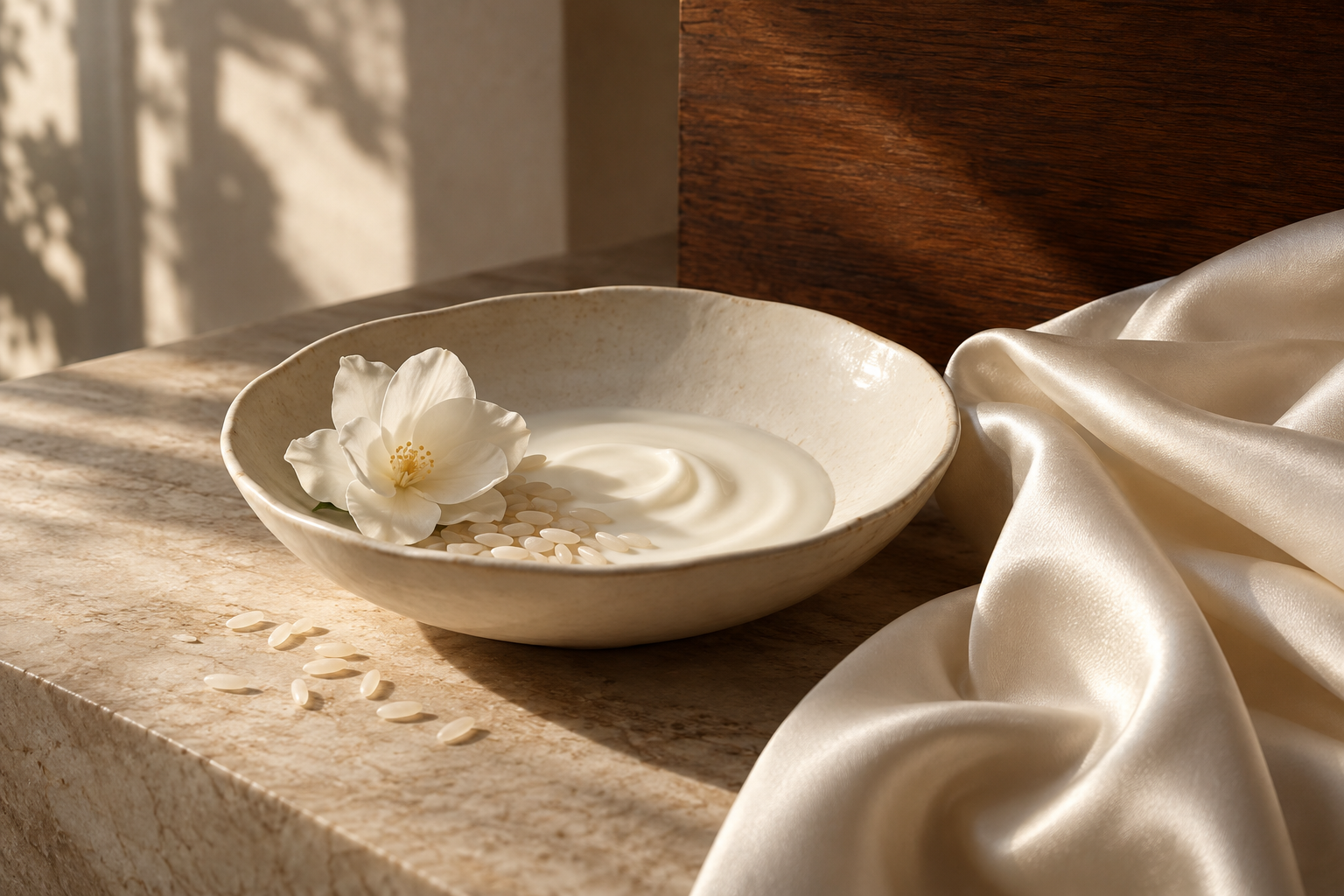
“Milky” is an unexpectedly domestic word to find on a perfume shelf. Between the extravagant flowers and the dramatic woods, somebody has put down a glass of milk.
I like the interruption. Milk suggests a temperature and a surface before it suggests an occasion. Cool and almost opaque; warm and faintly sweet; whipped into something that barely seems solid. Those are already different moods, and none requires a grand entrance.
Then matcha gets involved. The pale picture acquires a green mark, and I find myself more interested in the mark than in the milk.
Sunday leaves something green at the edge of the cup
Arielle Shoshana Sunday brings matcha and rice milk together with cinnamon, maté, cardamom, coconut, amber, sandalwood and vanilla in its published notes.
That is quite a full cupboard for so quiet a name. The tea is where I would linger. I imagine the uneven green at the edge of a pale cup, a little residue that refuses to disappear into the smoothness. It gives milk something to do besides being comforting.
Rice milk also changes the association. The softness need not point towards a glass of dairy milk or a bowl of whipped cream; it can belong to tea, grain and spice. Maté and cardamom put other aromatic interests on the page. Coconut and vanilla remain in the same composition, so it would be too quick to turn Sunday into a purely austere tea fragrance. The pleasure lies in the meeting.
I like a perfume idea that keeps a trace of its distraction. A leaf in a creamy subject, a spice somewhere it could easily have been smoothed away. In a trial, I would want to know whether the tea remains the attraction once the softer and warmer parts have settled. Rice milk and coconut belong to this particular arrangement; they are not promises made by the word lactonic itself.
Lactonic describes an impression
In perfumery, lactonic refers to impressions associated with lactones, a chemical family that includes creamy or fruity aroma materials; it is not a promise of a literal milk smell. Think of it as a way to describe texture, alongside powdery or woody. The impression can bring cool milk, coconut cream, nut milk or something richer and whipped to mind.
The family has some unexpectedly fruity relatives. PubChem describes gamma-undecalactone as peach-like and gamma-nonalactone as coconut-like. I find the peach especially useful here. The imagined glass can acquire the suggestion of fruit without becoming any less rounded or creamy. Coconut takes it somewhere else again. Milk is beginning to look less like a chemical destination and more like an impression assembled along the way.
That range is useful when five perfume descriptions give us rice milk, a milk accord, coconut and vanilla in different arrangements. Expecting the same dairy smell from each would smooth away the very differences that make Sunday’s tea or Blanche Bête’s flowers interesting. A creamy impression can lead us towards fruit, grain or petals. The name of the texture leaves quite a lot open.
A milk accord is an aromatic construction. Its name does not establish that dairy milk went into the bottle, nor does a coconut-like smell identify a particular coconut ingredient. A scent description and an ingredient declaration have different jobs. For dietary, ingredient or other formula requirements, ask the house about the exact product rather than making the note list answer for it.
The more useful aesthetic distinction is between creaminess and sweetness. They can be very close companions. They can also pull apart. A creamy wood or flower may offer the smoothness you want without producing the effect of a dessert, while a vanilla-rich composition may make indulgence its main subject.
I find “soft” equally slippery. It can describe a rounded surface, a powdery edge, a mood, or the amount of scent someone expects to notice. The first three do not settle the fourth. We will come back to the room around the perfume; for a moment, I want to stay with the flowers.
Blanche Bête makes the milk less domestic
Milk accord and ambrette meet jasmine and tuberose in Liquides Imaginaires Blanche Bête. Incense, cacao, tonka and a musky vanilla base give the white-floral heart a more complicated setting.
Tuberose is a consequential guest. It takes the imagined glass of milk out of the kitchen and towards an entire flower, full of its own interests. I am drawn to that enlargement of the subject. Creaminess does not have to make a perfume small, or gentle in every sense.
There is an opaline quality to the picture the notes suggest: light moving across a pale surface, with something held inside it. Incense and cacao are useful disturbances in that picture. They keep the whiteness from becoming empty.
White flowers and white milk are such similar colors in the imagination, and such different things. A petal has an edge; a creamy surface seems to absorb it. That small visual confusion is what I enjoy in the idea of this pairing. The flowers remain central to the description. Someone choosing Blanche Bête for its milky character is choosing that floral presence as well.
Against Sunday’s tea and rice milk, the change of scale is revealing. One description makes room for an aromatic leaf; the other opens into flowers, incense and a deeper base. Calling both milky is accurate as a family resemblance and incomplete as a buying decision. I rather enjoy how quickly that modest word has become insufficient.
Cold milk against warm wood
Commodity Milk Expressive sets cold milk and marshmallow against mahogany and tonka. The house calls this version sweet, woody and lactonic; its current note description also includes toasted sesame and benzoin.
Cold and warm occupy the same sentence here. That is the detail that interests me. A cool, smooth milk accord with a warmer woody foundation creates a more particular idea than softness alone. The toasted sesame adds another possible edge to the picture, without requiring us to imagine a dessert with a very precise recipe.
The mahogany has weight in that description. After the tea cup and the pale flowers, wood gives the creaminess a firmer surrounding. I can see why someone might arrive for the milk and stay interested in the foundation underneath it. It is a useful question to take into the sample: how much of the attraction belongs to the sweetness, and how much to its woody setting?
There is a practical complication in the name. Order Milk Expressive deliberately. Milk Personal and Milk Bold are separately presented products, with different supporting notes and intended presence. Commodity’s own distinctions are worth reading before choosing. An account of one version is not a wearing test of the other two.
I am wary of selecting between them through an abstract wish for more or less. The exact composition still matters. Greater presence does not automatically preserve every detail you enjoyed in a quieter version; a softer label does not guarantee your favorite balance. The bottle you tried is the one whose name needs to survive the journey to checkout.
Vanilla, with the milk moved forward
Ellis Brooklyn Vanilla Milk Eau de Parfum combines a creamy milk accord with two vanilla materials, cocoa shell and a floral opening. Amyris, sandalwood, benzoin and musk form its published foundation.
Cocoa shell holds my attention. It is a smaller, more specific image than an overflowing bowl of chocolate, and it sits intriguingly beside all that cream and vanilla. Again, the detail at the edge makes the central softness more interesting to contemplate.
I can happily stay with the vanilla for a while. Familiarity can be a lovely thing in perfume, the part that lets the rest of a composition become strange without making it remote. Here the cocoa shell and the floral opening have that familiar center to move around. The two vanilla materials in the house’s description suggest a subject with its own internal variety, before milk has changed the surface at all.
The useful comparison is with a vanilla you already know. Keep that reference on a separate blotter and notice what the milky accord changes in this one: a fuller surface, a different relation to the flowers, a roundness around the woods. The question is what the second composition adds to your own collection, rather than whether vanilla has somehow become an entirely new subject.
Sunday also contains vanilla. So does the base of Blanche Bête. Their other interests have already taken those compositions elsewhere. Vanilla Milk gives the familiar word a more prominent place in the name; it should not make us forget that the entire arrangement is what we will be wearing.
Fresh Cream does not arrive with a long speech
Philosophy Fresh Cream Eau de Toilette is described through creamy vanilla, heliotrope and tonka.
After incense, matcha, mahogany and cocoa shell, the short list has a certain charm. A soft, sweet confectionery mood can be a complete desire. Sometimes the elaborate account of a fragrance is the last thing one wants from it.
Heliotrope still matters. The creaminess has company, even in a concise description, and a trial can tell you whether that softer finish is the pleasure you were looking for. I would give Fresh Cream room beside one of the more woody or floral examples without asking it to apologize for being direct.
Choose the original Fresh Cream Eau de Toilette for this comparison. Fresh Cream Warm Cashmere has its own identity, and the family’s creams and other fragrance products require their own checks. Similar packaging can make a whole shelf look more interchangeable than it is.
Five different ways to make a milky perfume
Here is a quick reference to the five compositions. The scent cues come from the houses’ descriptions; the final column keeps the practical decision attached to the texture rather than to a ranking.
| Fragrance | Published scent cues | Direction to explore | What to decide on skin |
|---|---|---|---|
| Commodity Milk Expressive | Cold milk, marshmallow, mahogany, tonka | Milky sweetness with a woody foundation | How much warm wood you want around the creaminess |
| Liquides Imaginaires Blanche Bête | Milk accord, ambrette, tuberose, incense, cacao | Creamy white flowers with depth | Whether the floral presence is part of the pleasure |
| Arielle Shoshana Sunday | Rice milk, matcha, cinnamon, coconut, sandalwood | Tea and rice milk with gentle spice | Whether you enjoy an aromatic edge around the softness |
| Ellis Brooklyn Vanilla Milk Eau de Parfum | Milk accord, vanilla, cocoa shell, amyris, sandalwood | Vanilla-rich creaminess with woods | How milk changes your familiar idea of vanilla |
| Philosophy Fresh Cream Eau de Toilette | Creamy vanilla, heliotrope, tonka | A sweet, soft confectionery direction | Whether a simpler creamy mood gives you the effect you want |
A creamy surface, a powdery finish, a nut at the center
Powder and milk can both be called soft, but I do not picture them in the same way. Powder suggests a matte finish. Milk holds a little gleam. That distinction is an image rather than a formula, yet it can help name what you want from a sample.
Nuts introduce another surface. An almond association can lead towards pastry; a toasted edge can give a creamy impression more texture; coconut may bring a sunlit body cream to mind. There is no need for every one of those associations to end at the same dessert.
Our pistachio perfume guide follows a nutty center through gelato, woods, flowers and leather. The marshmallow perfume guide explores an airier confectionery idea. Milk and marshmallow may appear together, as they do in Commodity’s description, but smooth creaminess and fluffy sweetness remain separate qualities worth noticing.
That distinction prevents a familiar disappointment: asking for milk, choosing the sweetest-sounding bottle and discovering that sugar was never the thing you wanted. You may have been looking for the rounded edge around a wood, or for the way a flower could seem more opaque.
Soft is not a volume setting
The texture does not tell you how far the fragrance will travel in a small room. Start with a restrained amount, follow the exact product’s directions and try it in familiar surroundings. A creamy mood can still have substantial presence.
Warm air may change your impression of a rich perfume compared with cool air. Notice that without assigning every milk accord to the same season. The tea, the flowers, the woods and the amount you apply have more to say than the shared word on the label.
For a useful first comparison, choose two genuinely different directions: tea or wood beside flowers or vanilla-rich cream. Wear each alone before comparing on separate days, and keep amounts and scented body products consistent. An unplanned lotion can turn a clear comparison into another composition entirely.
Give creaminess and sweetness separate lines in your notes. “Very creamy, gently sweet” and “sweet vanilla with some milky softness” point towards different next choices. Then add the detail that held your attention later: tea, tuberose, warm wood. The opening may have supplied the milk; the rest of the day will tell you whether its company suits you.
Tea turns up again, closer to home
IRFĒ Marshmallow Musk places Earl Grey tea and flowers around marshmallow cotton, airy vanilla and powdery musk. Its published notes do not claim a milk accord. The connection here is texture and a particular interest in softness, with tea refusing to stay entirely in the background.
I find that refusal appealing. At the beginning I wanted to look at a glass of milk; now the tea, the tuberose and the warm wood have acquired lives of their own. The pale center is still there. It has simply become much better company.
