


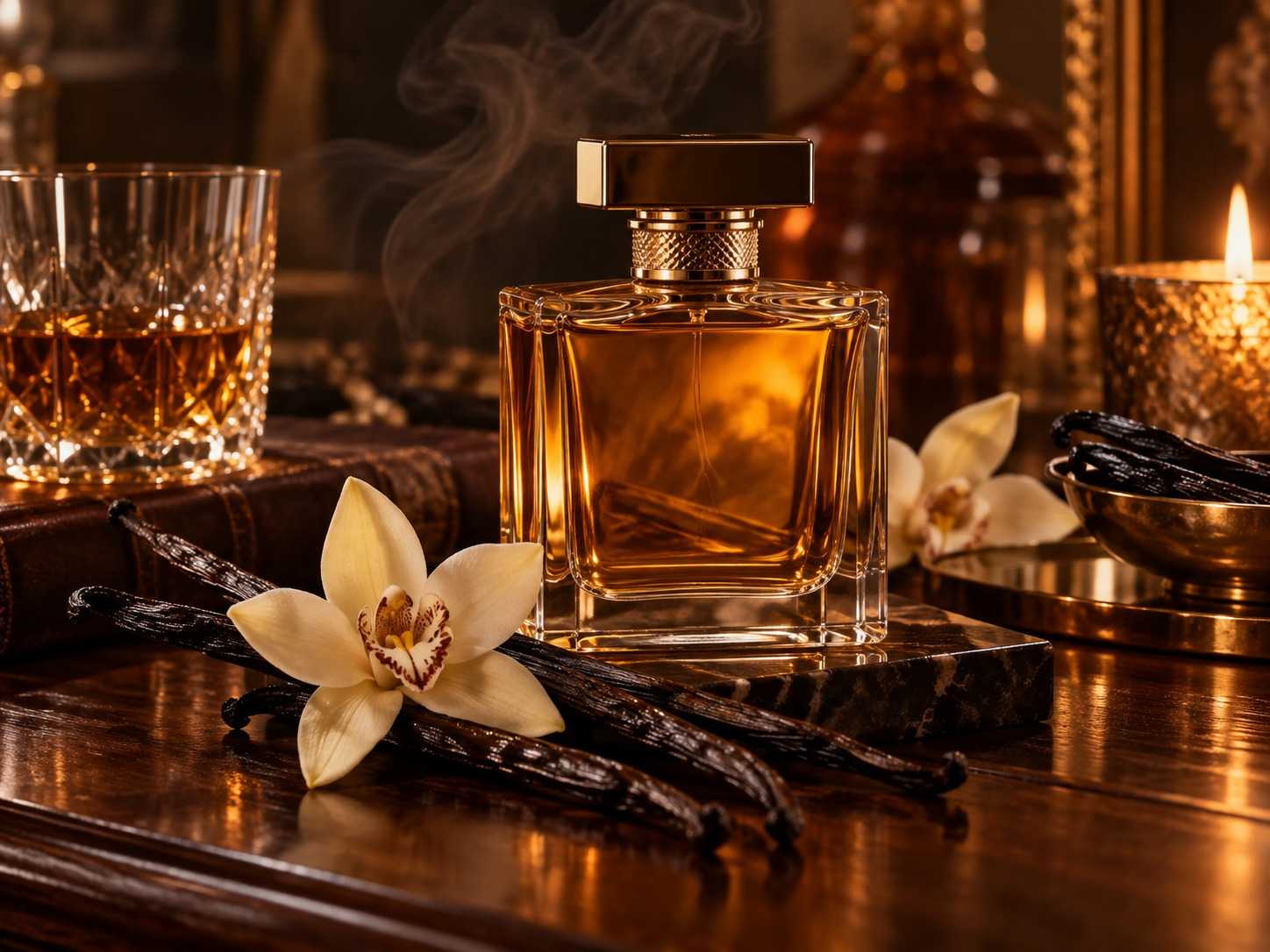
Bourbon vanilla has the sort of name that invites a scene before a fragrance has even touched the skin: dark wood, a low light, something warm in a glass. Sometimes the perfume follows that suggestion. Sometimes it is floral, softly powdered or almost transparent. The name alone does not decide.
That is the first distinction to make when choosing a vanilla bourbon perfume. Bourbon vanilla is not simply vanilla mixed with bourbon whiskey. The words can refer to a vanilla material, the name of a finished fragrance, or a boozy effect created by an entirely different combination of notes.
Separating those meanings makes the category more interesting, not less romantic. It allows you to choose the warmth you actually enjoy: creamy vanilla, floral sweetness, resinous depth or vanilla caught between smoke and leather. This guide follows those differences rather than treating every bottle as a variation of one imaginary perfume.

Bourbon Vanilla, Vanilla Bourbon and a Boozy Accord
The historical name Bourbon is associated with Réunion, formerly Île Bourbon. In the vanilla trade, it is used for a recognized Indian Ocean vanilla tradition, including Madagascar. The producer Escale Bleue describes Bourbon vanilla as Vanilla planifolia from this region. It is not named after an American whiskey recipe.
In perfumery, however, the label on the front of the bottle is not a complete ingredient declaration. A fragrance called Vanilla Bourbon may advertise a particular vanilla absolute, place vanilla inside a musky floral structure, or simply use the name to establish a warm mood. Read the maker’s account before filling in the missing details yourself.
| Term | What it can mean | What it does not establish |
|---|---|---|
| Bourbon vanilla | A vanilla designation connected with the Indian Ocean growing tradition | That whiskey has been added, or that a perfume will smell alcoholic |
| Vanilla Bourbon on a bottle | The name of one specific finished fragrance | That other similarly named perfumes share its formula |
| Boozy vanilla | A perceived or deliberately described rum, liqueur or whiskey-like effect | The botanical origin of the vanilla material |
| Vanilla absolute or extract | A type of aromatic material identified by the producer | The percentage used in the finished perfume or its eventual wear time |
This distinction matters at the fragrance counter. Someone asking for Bourbon vanilla may want a rich botanical impression, while another person wants the warmth of a spirit barrel. They could leave with quite different perfumes and both have made a sensible choice.
What Does Bourbon Vanilla Smell Like in a Perfume?
The most useful vocabulary is warmer and more varied than “sweet.” Vanilla can suggest cream, cured pods, soft powder, balsamic warmth or a darker, almost woody richness. The surrounding composition determines which part becomes prominent. Citrus may cut through it; flowers give it volume; smoke and leather make the same warmth feel less edible.
Think of the difference between an ivory fabric under daylight and the same fabric under amber lamps. Its identity has not vanished, but the atmosphere has changed. In perfume, vanilla gains a similar change of character through context. A sugar note pushes it toward dessert. Dry wood or incense can give it a more severe outline.
Do not assume that a darker liquid must smell deeper, or that an elaborate note pyramid must produce a more interesting vanilla. Those are visual and verbal clues, not a substitute for smelling. The decisive question is what happens after the first impression: does the warmth become more nuanced, or merely sweeter?
Four Fragrances That Clarify the Difference
These are four different interpretations, not a ranking of identical products. Two makers explicitly use Bourbon vanilla in their descriptions, one places it inside a dark IRFĒ composition, and the final example demonstrates a deliberately boozy vanilla direction. The sensory readings below are editorial, based on disclosed notes rather than an invented personal wear diary.
NEST Vanilla Bourbon Eau de Parfum: a name with a floral-musky setting
NEST Vanilla Bourbon is a finished fragrance whose name should be read literally as a product name. NEST pairs vanilla bourbon absolute with orange bitters, brown sugar, night-blooming jasmine and soft musk. Its description gives a much clearer buying direction than the word Bourbon on its own.
For an editorial reading, notice the balancing elements. The orange note supplies a sharper opening idea; jasmine gives sweetness a floral dimension; musk suggests a softened finish. This is the route to consider when the attraction is warm vanilla with a composed floral frame, rather than smoke and a leather jacket.
The question to ask on skin: do you enjoy the meeting of floral volume and sweet warmth? Readers seeking something dry should not assume that the name promises the austerity of whiskey or oak.
Valentino Donna Born in Roma Eau de Parfum: Bourbon vanilla beneath jasmine
The original Valentino Donna Born in Roma Eau de Parfum places vanilla Bourbon alongside jasmine and a woody cashmeran character. This is the original eau de parfum, not a substitute description for Born in Roma Intense or another flanker.
It provides a useful alternative to the idea of a solitary vanilla pod. The floral structure matters. In wardrobe terms, the attraction is a dressed silhouette with softness inside it: the flowers create presence, while vanilla gives that presence a warmer finish. The comparison is not about which ingredient sounds more expensive, but which relationship you prefer.
The question to ask on skin: are you looking for vanilla as the main subject, or do you prefer it supporting a more obvious floral perfume? A beautiful jasmine-vanilla is not an unsuccessful pure vanilla; it is doing a different job.
IRFĒ Smoldering Pepper: Bourbon vanilla in a dark, spicy frame
IRFĒ Smoldering Pepper lists Bourbon vanilla with smoked leather and oud in its base. Black pepper, saffron and olibanum open the composition; labdanum, patchouli and cypriol shape the heart. Its official fragrance family is Oud Spicy.
The relevant IRFĒ example is therefore Smoldering Pepper, not a separate fragrance named “IRFĒ Vanilla Bourbon.” Vanilla belongs to a structure with spice, resin, smoke and wood. It supplies warmth within the darkness rather than turning the entire perfume into a gourmand.
The editorial appeal is contrast: a dry lapel against a softer lining, a controlled shape with warmth underneath. This direction belongs on the shortlist when conventional sweet vanillas feel too simple, but leather and incense already have a place in your fragrance wardrobe.
The question to ask on skin: do you want the whole pepper-and-oud composition, or only its vanilla note? Buying for one base note while disliking the main character is a common way to purchase a beautiful bottle that never gets worn.
Guerlain Spiritueuse Double Vanille: a useful reference for boozy vanilla
Guerlain Spiritueuse Double Vanille is included to clarify the other meaning shoppers often have in mind. Guerlain describes rum accents around vanilla, with benzoin, cedar and floral facets. The boozy impression is part of its described character, not something that must be inferred from the word Bourbon.
This is the direction to consider when your imagined vanilla includes polished wood, a softer glow and the suggestion of a drink without becoming a literal cocktail. Its purpose in this comparison is not to prove that all rich vanilla is alcoholic. It demonstrates why the surrounding description matters.
The question to ask on skin: does the spirit-like warmth remain attractive as the fragrance settles? Some people enjoy that effect most in the opening and prefer a less boozy finish. Others want it to remain central.

Read the Supporting Notes as a Styling Decision
Once the name is clear, look at what surrounds the vanilla. A fragrance cannot be predicted perfectly from its note list, but the description should give you a useful starting direction.
For a softer, more intimate mood, compare vanilla with musk and pale woods. The point is not necessarily reduced sweetness; it is a softer edge. Our vanilla and musk guide concentrates on that relationship.
For resinous warmth, look at the role of amber materials, incense and balsamic notes. These can make vanilla feel more enveloping or give it a darker background. The amber vanilla guide separates that idea from a straightforward sugary gourmand.
For a sharper opening, compare vanilla with bergamot. The citrus does not remove vanilla’s warmth; it changes the entrance. It is a useful direction when you like the drydown of sweet fragrances but find their first impression too heavy.
For a more assertive evening character, consider leather, pepper, tobacco or oud. Those notes should be part of what attracts you, not obstacles you expect the vanilla to conceal. The best contrast is one whose two sides you genuinely enjoy.
What the Material Name Cannot Tell You
A named origin can be meaningful, but it does not reveal the full formula. A perfume may combine a vanilla extract with other aroma materials. The note list also does not tell you how much is used, how the fragrance will project, or whether the vanilla will dominate the composition.
Natural and synthetic are not reliable shorthand for “luxurious” and “inferior.” Judge the finished scent and look for specific evidence when a brand makes a sourcing claim. A beautiful composition needs balance; a valuable raw material does not perform that work by itself.
The same restraint applies to ethical language. A statement about one ingredient is not proof of the entire product’s environmental or social impact. Readers interested in the Maison’s own disclosed materials can consult the IRFĒ fragrance ingredients page, while keeping a distinction between a sensory description and a sourcing record.
Choosing a Style for Day, Evening and Colder Weather
For daytime, consider how much space you want the fragrance to occupy. A floral or musky vanilla may complement an open collar and lighter tailoring; a resinous composition may feel better when your whole look has more weight. Neither choice is fixed by gender or the season printed in an advertisement.
For evening, there is often room for a more deliberate contrast: polished wood against sweetness, flowers against smoke, a restrained vanilla beneath leather. Think in terms of presence rather than maximum strength. A scent should complete the atmosphere around you, not replace it.
In colder weather, richer vanillas can suit the mood of heavier clothes and warmer interiors. But personal comfort remains the useful test. A perfume that feels inviting outside can become too much in a small room. Wear a sample through the transitions that make up your actual day, rather than selecting solely for a photographed winter fantasy.
How to Evaluate Wear Without Borrowing Someone Else’s Result
Do not use the word Bourbon as a shortcut for lasting power. Compare the opening, the heart and the late drydown. Note whether vanilla remains the main subject or gives way to woods, flowers or musk. Also separate how long you can detect it close to skin from the size of its scent trail.
A useful test is to wear two contrasting samples on different days under similar conditions. Write down what remains attractive, not just what remains detectable. A quieter perfume that you continue to enjoy may be the better purchase than a forceful vanilla you cannot wait to wash off.
For a broader choice of styles, the main vanilla perfume selection covers other directions. Keep this page’s distinction in mind: material, product name and boozy impression are separate decisions.
Layering: Keep the Contrast Visible
Layering is most useful when the intended change is small and clear. A simple musky fragrance may soften a sharply contrasting vanilla; a citrus-led fragrance may give a sweeter composition a brighter introduction. There is no need to turn an already complex perfume into a second formulation project.
Wear both products separately before trying them together. Use modest amounts, compare the combination with each fragrance alone, and avoid mixing them into the original bottles. More vanilla does not necessarily produce more depth. It can simply fill every space that previously allowed the woods or flowers to be noticed.
Smoldering Pepper, in particular, already brings several strong contrasts together. Its inclusion in a vanilla guide is an invitation to understand the full structure, not a recommendation to pour a vanilla oil over it. Begin with the composition as the perfumer presents it.
Frequently Asked Questions
Does Bourbon vanilla perfume smell like whiskey?
Not necessarily. Bourbon vanilla is a vanilla designation connected with the Indian Ocean region. A whiskey, rum or liqueur-like impression depends on the finished fragrance and its supporting notes. Look for an explicit description rather than assuming the name guarantees it.
Is there one perfume called Vanilla Bourbon?
The words are used in different product names and descriptions. NEST Vanilla Bourbon is one specific fragrance. Always check the brand, exact product name and concentration before comparing bottles or reading reviews.
Which IRFĒ perfume contains Bourbon vanilla?
Smoldering Pepper lists Bourbon vanilla in its base with smoked leather and oud. It is a spicy oud composition, not a standalone IRFĒ product called Vanilla Bourbon.
Can women and men wear this style?
Yes. A floral treatment, a simple musk and a smoky oud interpretation offer very different choices. The balance you enjoy is more useful than treating vanilla as belonging to one gender.
Does Bourbon vanilla guarantee a long-lasting fragrance?
No. The material name does not establish a wear-time result. Judge the particular formula and distinguish longevity from projection when comparing samples.
Warmth With a Clear Identity
The most rewarding vanilla bourbon perfume is the one whose warmth has a recognizable shape. That might be jasmine over vanilla, a musky softness, a resinous evening glow or the darker architecture of spice and leather. Once the name stops doing all the work, the fragrance itself becomes much easier to choose.
Sources and disclosure: the origin distinction follows Réunion’s tourism information and Escale Bleue’s producer information. Product notes follow the linked fragrance houses. IRFĒ publishes this guide and sells Smoldering Pepper; editorial style assessments are not independent wear-test results.
