



You know the moment someone asks for “dark, warm, a little sweet,” and expects you to translate it into one decisive bottle? In U.S. boutiques, the request often points straight at the black opium perfume style, even when the shopper does not say the name.
I have watched this profile outperform trendier launches because it reads polished in low light and expensive up close.
I’m Olga Sorokina, and after years moving from modeling to reviving Maison IRFE at Haute Couture Week in Paris, I learned that the best “night” choices feel structured, not sugary.
So I’m going to define what “dark-sweet” actually is, explain why Black Opium became the shorthand, and show you how to test and refine the vibe until it feels like yours.
Key Highlights
- Black Opium (2014) set the modern “coffee + vanilla + white flowers” template that many shoppers now use as a reference point.
- The official note pyramid matters: pear, pink pepper, and orange blossom on top; coffee and jasmine in the heart; vanilla, patchouli, cashmere wood, and cedar in the base.
- Review volume signals cultural reach: as of January 2026, Influenster shows a 4.78/5 average from 2,426 reviews for Black Opium Eau de Parfum, which helps explain why it is so often recommended as a “safe” night scent.
- Don’t judge on the first spray: I decide after 3 to 5 wears, with at least one true night-out wear, because this profile changes dramatically from opening to drydown on different skin.
- To make it feel more couture: keep the coffee-vanilla core, then sharpen the silhouette with dry woods, leather, tobacco, vetiver, or incense, instead of adding more dessert notes.
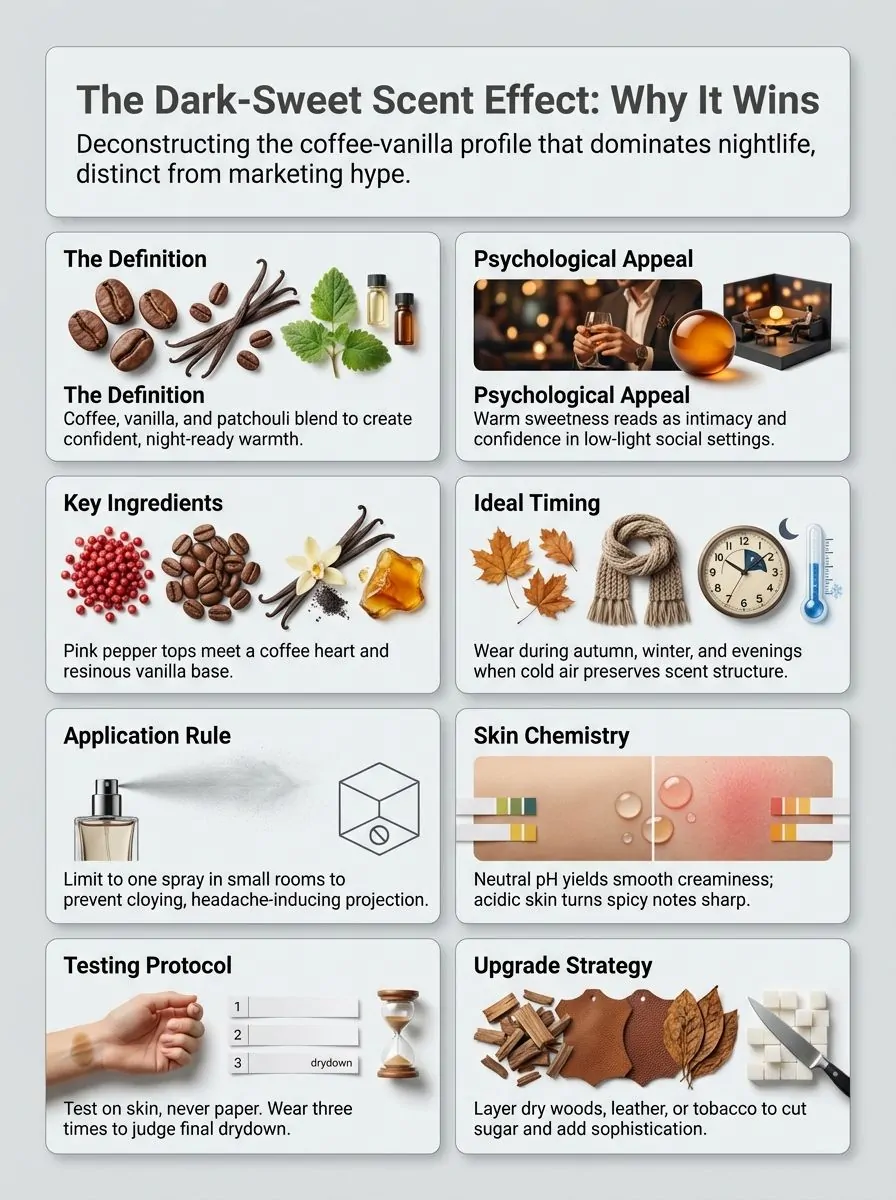
– What “dark-sweet” means in real-life scent terms (not marketing)
“Dark-sweet” is a contrast effect. You get edible sweetness (often vanilla or a soft amber) held in place by something deep, bitter, or resinous, like coffee, patchouli, or smoky woods.
On paper it sounds simple. On skin, it is the difference between “dessert” and “after-dark.”
Black Opium by Yves Saint Laurent is the archetype because its coffee and vanilla are lifted by white florals, then grounded by patchouli, woods, and that “cashmere wood” softness.
- If you smell pear and pepper first: expect a bright entry before the deeper notes arrive.
- If coffee reads bitter on you: you will get more “edge” than “candy.”
- If vanilla blooms fast: you may need fewer sprays, especially indoors.
- If patchouli feels earthy: you will likely prefer the drydown more than the opening.
The Dark-Sweet Bestseller Effect happens because this structure performs in real life: it feels cozy at arm’s length, then turns more intimate as the base warms on skin.
– Why this profile became the modern default for nightlife
Nightlife is a performance space. In loud rooms, you want a fragrance that reads quickly, then stays interesting once you are close.
Black Opium’s coffee-floral core does exactly that, it announces itself early, then settles into vanilla and woods that feel more like fabric than sugar.
YSL describes Black Opium Eau de Parfum as a warm and spicy fragrance built around coffee, white flowers, and vanilla, which is basically the blueprint for “dark-sweet” in 2026.
- Fast recognition: coffee and vanilla register even when the air is crowded.
- Low-light friendliness: warm notes feel richer at night, while crisp notes can feel sharp.
- Compliment mechanics: this profile tends to read “approachable” first, then “seductive” later, which is why it gets repeated.
– What people usually mean when they say “I want something sexy”
In my experience, “sexy” rarely means one specific note. It means a warmth that feels intentional, plus a drydown that leaves a memory.
I wore Black Opium on a Paris night after its 2014 launch and watched the room respond as the coffee and vanilla softened into a glowing base.
Sexy means warmth, confidence, and a memory that pulls people closer.
There is research behind the idea that scent strengthens memory. A 2010 paper in the Journal of Consumer Research found product scent can improve recall for information and associations for up to two weeks after exposure.
- If you want “sexy” without shouting: ask for coffee, vanilla, and white florals, then request a woody or patchouli base.
- If you want “sexy” with more bite: look for pepper, saffron, or a smokier wood in the opening.
Watch a quick wear-and-impressions video
Why People Search “Black Opium Perfume” Specifically
People search “black opium perfume” because it is a shortcut. It signals a very specific mood: warm, dark, sweet, and confident, with enough edge to feel adult.
The name also helps shoppers shop faster. In the U.S., it is stocked widely, and the line offers multiple sizes and flankers, which makes trial easier than with many niche scents.
As of January 2026, YSL Beauty US lists Black Opium Eau de Parfum in 10 mL, 30 mL, 50 mL, 90 mL, and 150 mL sizes, and the 90 mL is priced at $172.
| What you are really searching for | How to translate it at the counter |
|---|---|
| “Warm, sweet, night-ready” | Coffee and vanilla with white florals |
| “Less common” | Same warmth, but add dry woods, incense, or leather |
| “More intense” | Try a stronger flanker, then compare drydowns on skin |
I will next dissect the signature notes that create the dark-sweet effect.
– Is the search for the brand… or for the feeling it represents?
Most of the time, it is the feeling. The name becomes a label for a silhouette, the same way a black dress can mean ten different things depending on cut.
If you suspect you are chasing the mood, use a trial strategy that protects your taste and your budget.
- Start small: pick a travel spray or mini first, then decide after real wears.
- Compare in the same night: one wrist Black Opium, the other your alternative, and do not re-spray.
- Decide at the drydown: if you do not love hour three, you will not love the bottle.
Video: brand DNA versus the feeling
– What expectations people bring before the first spray
Shoppers come in expecting three things: instant impact, a flattering sweetness, and performance that holds through the evening.
That is why “night” fragrances get judged harshly if the opening is stunning but the base goes flat.
- Expectation to sanity-check: “long-lasting” is personal, so test on skin and on fabric.
- Expectation to keep: you want a base that feels textured, like woods, patchouli, or amber.
- Expectation to drop: you do not need massive projection in close spaces, you need the right distance.
– Why this name became shorthand for a whole category
Black Opium became shorthand because the formula is easy to describe and easy to recognize, even for people who cannot name individual notes.
Fragrance references list it as an oriental-gourmand style built by four perfumers: Nathalie Lorson, Marie Salamagne, Olivier Cresp, and Honorine Blanc.
- Top: pear, pink pepper, orange blossom
- Heart: coffee, jasmine, with bitter almond and licorice nuances
- Base: vanilla, patchouli, cashmere wood, cedar
That structure is why critics compare it to other sweet night staples, the market learned the template and repeated it.
The Signature Scent Profile Behind Black Opium
Launched in September 2014, Black Opium offered a rock-and-roll reinterpretation of a classic idea: sweetness made darker with coffee and woods.
The scent blends coffee, pink pepper, orange blossom, jasmine, vanilla, patchouli, and cedar to create a dark-sweet style reference that reads modern and sensual.
I think of it like couture styling. Coffee gives a sharp line, vanilla gives softness, and the white florals keep the whole look from feeling too heavy.
- If it smells too floral on you: wait 30 minutes, the coffee usually reappears as it warms.
- If it smells too sweet on you: apply to the chest under clothing instead of the neck.
– Which notes/accords create the “sweet + depth” impression
The sweet-plus-depth impression comes from contrast layering. Bright fruit and pepper open the door, then coffee and jasmine take over, then vanilla and woods finish the story.
What I always watch for is the base. Patchouli and cedar are the backbone that keeps the sweetness from collapsing into syrup.
| Accord | What it does | How to use it |
|---|---|---|
| Coffee | Adds bitterness and tension | Use it for night energy, especially in fall and winter |
| White florals (jasmine, orange blossom) | Keeps the sweetness airy | Great if you dislike pure gourmands |
| Vanilla | Creates the “skin warmth” effect | Reduce sprays if vanilla blooms fast on you |
| Patchouli and woods | Gives structure and depth | Look for these if you want “adult” sweetness |
– Why coffee/vanilla-style warmth reads as confidence
Coffee reads as self-possessed. Vanilla reads as comfort. Together, they create a message that feels bold without feeling aggressive.
A 2015 beauty editorial from Allure framed Black Opium as a date-night essential, and that association stuck because the profile performs exactly where people want confidence the most.
- For a sharper edge: lean into pepper, saffron, or darker woods in your next purchase.
- For a softer edge: keep coffee, add creamy woods, and let florals do more work.
Cloying: when sweet turns sticky
“Cloying” is rarely a moral judgment. It is usually chemistry plus environment, too much sweetness, too much heat, or too much spray.
Heat changes everything. Fragrance performance guides note that warmth increases projection and can make dense sweet notes feel louder, while cold weather slows evaporation and makes rich notes feel smoother.
- If you run warm: spray lower on the body (chest under clothing) and skip the neck.
- If you are in a hot venue: go one spray and let it breathe.
- If your skin is dry: moisturize with an unscented lotion first, then spray once.
- If you get “headache sweet”: avoid layering with other gourmands, add woods instead.
Who Usually Loves This Profile (and Who Won’t)
This profile tends to attract people who want an evening signature that feels glamorous with minimal effort.
It also repels people who prefer crisp, airy, or purely floral perfumes, or anyone who gets overwhelmed by vanilla-forward drydowns.
| You will probably love it if you want | You will probably skip it if you want |
|---|---|
| Warmth that reads luxurious under low light | Fresh citrus, laundry-clean musks, or watery florals |
| Sweetness with a darker base | Zero sweetness or very minimalist compositions |
| A crowd-pleasing night scent | A niche scent that few people recognize |
Skin chemistry can flip the result. On some people it is creamy and smooth; on others it turns sharp, loud, or oddly musky.
The “signature-scent” buyer
I see two distinct customers in boutiques: the compliment-first buyer and the signature-scent buyer.
- Compliment-first: wants instant recognition and fast payoff, usually loves the opening and the attention it draws.
- Signature-scent: wants a personal armor effect, cares more about the drydown than the first 10 minutes.
- Collector: buys flankers to tune sweetness, intensity, or fruit, rather than abandoning the DNA.
In a 2025 conversation thread on Reddit’s perfume community, the most repeated advice about Black Opium was simple: do not blind buy, test it on skin first.
– Why some people read it as cozy, others as heavy
The cozy-versus-heavy split is a proportion problem. On the right skin and in the right temperature, coffee and vanilla feel plush, like cashmere.
On a warmer body, in a crowded room, or with too many sprays, the same notes can feel thick and persistent.
- Cozy version: one spray, cool air, a base that stays woody.
- Heavy version: multiple sprays, warm air, vanilla dominating early.
When it turns sharp
Sharpness usually shows up in the opening, where pepper and orange blossom can feel bright or “screechy” on certain skin.
Instead of chasing a new bottle immediately, adjust the wear.
- Move the spray: try the chest or inner elbow instead of the neck.
- Change the canvas: moisturize first if your skin is dry.
- Change the dose: one spray, then wait 20 minutes before deciding.
When It Works Best (Occasions + Seasons)
This is an evening profile by design, especially in fall and winter, when warm notes unfold more slowly and feel more refined.
I also like it for moments where your outfit already has drama, silk, velvet, leather, or tailoring with sharp shoulders.
- Date nights: it reads intimate without being fragile.
- Gala energy: pair it with darker styling and polished jewelry.
- Holiday gatherings: the vanilla-wood base matches the season’s warmth.
- After-hours dinners: it holds up against food, wine, and candlelit rooms.
– Why evenings make dark-sweet feel more elegant
Evenings change perception. Low light makes warm leads feel richer, and close conversation rewards a well-built base.
That is why dark-sweet scents often feel more “expensive” at 9 p.m. than they did at noon.
- Use the room: indoors needs less spray than outdoor terraces.
- Use the fabric: a light mist on a scarf can extend the mood without adding volume.
Heat: what changes on the skin
Heat accelerates evaporation. That usually means stronger projection up front, but a faster fade in the heart, and a quicker slide into base notes.
Cold does the opposite, it can make the scent feel closer to skin while extending wear.
- Hot conditions: apply lower on the body and reduce sprays.
- Cold conditions: you can add one extra spray, but still keep it controlled.
- Humidity swings: expect sweetness and musks to feel heavier in sticky air.
– The “one spray rule” for close spaces
I use one spray as the default for close spaces, offices, cars, restaurants, and anywhere you cannot escape someone else’s scent cloud.
If you need more presence, change placement first. Add a second spray only after you have tested the first for an hour.
- Spray once on the chest, under clothing.
- Wait 20 minutes for the alcohol to flash off.
- Check again at 2 hours, that is the real vibe.
Common Complaints (Without Being Snarky)
Black Opium gets criticized for the same reasons it sells: it is recognizable, sweet-leaning, and built for attention.
When people dislike it, they usually dislike the dose, the sweetness, or the way the drydown behaves on their skin.
- “Too sweet”: vanilla takes over too early.
- “Too common”: the DNA is now widely copied.
- “Headache”: too many sprays, warm room, or sensitivity to certain florals.
- “Opening is amazing, drydown is meh”: the base reads more generic on that skin.
– “Too sweet” / “too common” / “headache”
Those complaints are real, and they usually have a practical fix.
In several community discussions, people who struggled with it described quick fading on their skin or a sweetness spike in heat, while others described it as “nuclear” with strong projection.
- If it feels too sweet: stop spraying the neck and do one spray under clothing.
- If it feels too common: keep the DNA but shift to darker woods, leather, or tobacco in your next bottle.
- If it triggers headaches: avoid layering and test in the actual environment where you plan to wear it.
– Why those happen
Sweetness and “common” often travel together because the market repeats what sells.
Headaches often come from concentration plus context: a warm room, a heavy hand, and a formula that is designed to project.
| Complaint | Likely driver | Adjustment |
|---|---|---|
| Too sweet | Vanilla blooms fast on warm skin | Use one spray, lower placement |
| Too common | Many releases copy the coffee-vanilla idea | Choose a darker “upgrade note” (leather, incense, tobacco) |
| Headache | Over-application in close spaces | Try chest under clothing, then reassess at 2 hours |
– Why over-application ruins this style fastest
Over-application collapses the silhouette. Instead of contrast, you get a single loud block of sweetness and coffee.
This is the quickest way to turn “seductive” into “overwhelming.”
- Rule I use: if you can smell yourself constantly, other people are drowning.
- Fix: wash it off, then reapply once, lower on the body.
– When the opening is great but the drydown disappoints
This is common with dark-sweet scents. The top can feel cinematic, then the base becomes more generic if your skin eats the structure.
Before you give up, change how you test.
- Test on fabric: a light mist on a scarf can preserve the base longer than skin alone.
- Test after moisturizing: dry skin can shorten the satisfying middle.
- Test flankers: the same DNA can feel smoother, darker, or less sweet depending on the version.
What People Are Actually Looking For (Decoded)
Most shoppers want sweetness that reads adult. They want warmth that feels expensive, and a base that does not turn into pure sugar.
I translate the request into three checks: sweetness level, depth note, and how close it sits to the body.
| What they say | What they mean | What to ask for |
|---|---|---|
| “Sweet but not childish” | Vanilla with structure | Vanilla plus woods or patchouli |
| “Sexy but not loud” | Intimate projection | Chest placement, one spray, strong base |
| “Warm but not sugary” | Less dessert, more texture | Tobacco, leather, incense, vetiver |
– “Sweet but not childish”
Adult sweetness has architecture. It keeps a dry backbone under the vanilla, so the mood feels tailored.
- Look for: patchouli, cedar, sandalwood, or amber woods listed under the vanilla.
- Avoid if you go cloying easily: extra caramel, heavy marshmallow, or dense chocolate accords stacked on top.
- Ask for in store: “vanilla with woods,” not “extra gourmand.”
– “Sexy but not loud”
This is a placement decision as much as it is a perfume decision.
I aim for a scent that reads like a private detail, not a public announcement.
- Best placements: chest under clothing, inner elbow, back of neck (light mist).
- Skip if you are sensitive: spraying directly under the nose, like the front of the neck.
– “Warm but not sugary”
Warmth without sugar usually comes from spice, woods, resins, or tobacco, with vanilla used as polish rather than the main event.
That is where dark-sweet evolves into something more couture.
- Dry woods: cedar, sandalwood, cashmere woods
- Resins: labdanum, incense styles
- Dark accents: leather, tobacco, vetiver
Alternatives by Direction (Not Clones)
If you love the Black Opium mood but want to steer the silhouette, choose an alternative by direction, not by “dupe.”
As of January 2026, YSL Beauty US lists the 3.0 oz Black Opium Le Parfum at $205, and Sephora lists Black Opium Over Red at $140 for 1.6 oz, which is why I treat flankers like a targeted wardrobe purchase.
| Direction | Named option | What it changes |
|---|---|---|
| Less sugar, more club-room | Tom Ford Tobacco Vanille | Tobacco leaf and spice add dryness and weight, vanilla stays but feels darker |
| More darkness, more drama | Tom Ford Black Orchid | Truffle, plum, and patchouli push it into deeper, more decadent territory |
| More skin, more fashion-insider | Le Labo Santal 33 | Sandalwood, leather, and ambrox make it feel intimate and modern |
– If you want less sugar: what to look for
I look for vanilla that is tempered by spice, tobacco, or dry fruit, so the sweetness feels deliberate, not dessert-like.
Tom Ford describes Tobacco Vanille as a blend of tobacco leaf, ginger, spice notes, tonka bean, cocoa, and fruit accords, which is why it reads warmer and drier than many gourmands.
- Keywords to ask for: tobacco leaf, spice, tonka, woods.
- Testing tip: try it in a sweater or coat, that is where the richness makes sense.
– If you want more darkness: what to look for
If you want darkness, prioritize earth and shadow over sweetness. Think truffle, rum, patchouli, incense, or darker florals.
Tom Ford lists Black Orchid’s key notes as black truffle, ylang ylang, black orchid, black plum, rum absolute, and patchouli, which explains why it feels more nocturnal than coffee-vanilla styles.
- What to avoid: adding extra vanilla layers on top, that pulls it back into gourmand.
- What to do: wear it with darker styling and let it sit closer to skin.
– If you want more skin: what to look for
For a true “skin” effect, choose musks, ambrox-style woods, and sandalwood, and keep the sweetness restrained.
Luckyscent lists Santal 33 with notes that include sandalwood, leather accord, cardamom, cedarwood, iris, violet, and ambrox, which is why it reads like warm air around the body, not sugar on the surface.
- Application: one spray on the chest, one light mist behind the neck.
- Wardrobe match: white shirt, leather, minimal jewelry, clean lines.
How to Test This Style Properly
This profile can feel perfect for 10 minutes and wrong by hour two. That is why I test with a method, not a mood.
- Spray once on skin (inner wrist or inner elbow), then do not rub.
- Wait 20 minutes before you decide if it is “too sweet.”
- Re-check at 2 to 4 hours, this is where the base tells the truth.
- Do one real-world wear in the setting you actually want it for.
– How many wears you need before deciding
I need three to five wears before committing, and I space them out. Skin, weather, and outfit all change how the drydown reads.
- Wear 1: indoor evening, close conversation.
- Wear 2: colder day or night, see if it becomes smoother.
- Wear 3: a social setting, check if you go nose-blind or overwhelmed.
– Why paper strips lie for dark-sweet scents
Paper exaggerates the opening and flattens the base. With dark-sweet perfumes, that usually means “more sugar, less structure.”
If a dark-sweet scent feels perfect on paper but chaotic on skin, trust skin. This style is built for warmth, not cardboard.
– The best places to apply for honest results
Application is styling. A different placement can make the same bottle feel more refined.
- Most honest: chest under clothing, inner elbow.
- Most risky for sweetness overload: front of neck and collarbone.
- For a soft trail: a light mist on a scarf (test fabric first).
The Upgrade Path: From Bestseller to Personal Signature
Once you know you like the Black Opium direction, upgrade by adjusting texture, not by adding more sugar.
I treat it like tailoring. Keep the recognizability, then refine the line.
- To sharpen: dry woods, vetiver, incense.
- To darken: tobacco, leather, rum notes, deeper patchouli.
- To modernize: ambrox-style woods and clean musks, used lightly.
– How to keep the vibe while sounding more “you”
Pick one anchor note you love (coffee or vanilla), then choose one contrast note that changes the silhouette.
- Coffee + leather: sharper, more editorial.
- Vanilla + dry woods: softer, more expensive.
- Coffee + incense: darker, more dramatic.
- Vanilla + tobacco: warmer, less sugary.
Keep doses small. One or two sprays create presence without crowding the room.
– Which note families shift it toward sophistication
For sophistication, I look for dryness and texture. That usually means woods, resins, tobacco, and a restrained leather effect.
| Note family | What it adds | Who it flatters most |
|---|---|---|
| Dry woods (cedar, sandalwood) | Structure and polish | Anyone who finds gourmands too youthful |
| Resins (incense styles, labdanum) | Depth and shadow | Evening wear, black-tie moods |
| Tobacco | Warmth without syrup | People who want “sexy” with edge |
| Leather (restrained) | Editorial sharpness | High-fashion minimalists |
– How to stop chasing hype and choose profile
I stop chasing hype by naming my goal in plain words: sweet level, darkness level, and how close I want it to sit.
- Sweetness: vanilla polish or dessert vanilla?
- Darkness: coffee edge or resin shadow?
- Distance: intimate skin-scent or room-filling?
Then I test on skin, at night, and decide at the drydown.
Last Words
The Dark-Sweet Bestseller Effect is not magic. It is structure, contrast, and performance in the settings where people want to feel unforgettable.
If you love black opium perfume energy, make it work harder for you by testing properly, applying with restraint, and upgrading the base notes instead of adding more sugar.
Choose the version that feels tailored on your skin, and let that be your signature.
– The real reason this profile sells (psychology, not mystery)
Dark-sweet sells because it pairs comfort with tension. Vanilla soothes, coffee and woods add edge, and the result reads confident in close conversation.
There is also a memory factor. Product scent research has shown that scent can strengthen recall and association, which helps explain why “that night perfume” becomes a repeat purchase.
- Action: if you want compliments, prioritize recognizability and smoothness.
- Action: if you want a signature, prioritize the drydown texture and how it sits on fabric.
– The one question to ask before committing
Ask this: will this smell like me at hour three, in the room where I actually live my life?
I test dark-sweet perfumes at night because that is when the profile shows its real balance between coffee edge, vanilla comfort, and base-note structure.
- If the drydown feels flat: do not buy the bottle.
- If the drydown feels tailored: commit, and wear it like an accessory with intention.
FAQs
1. What is the Dark-Sweet Bestseller Effect?
The Dark-Sweet Bestseller Effect is a scent profile that mixes dark notes with sweet notes to make a warm, bold aroma. This profile feels rich and familiar, and it often tops sales charts.
2. Why does the Dark-Sweet Bestseller Effect keep winning?
It taps memory, comfort, and a hint of luxury that many people like. The scent hits both sweet and deep layers, which makes it easy to wear and hard to forget.
3. How do perfumers build a dark-sweet bestseller?
They layer top, heart, and base notes to balance bright sweet tones and dense dark tones. They use fixatives and the right concentration to boost longevity and mouthfeel for the scent.
4. Can the Dark-Sweet Bestseller Effect work beyond perfume?
Yes, brands apply this scent profile to candles, body care, and home blends to drive appeal and repeat buys.
