


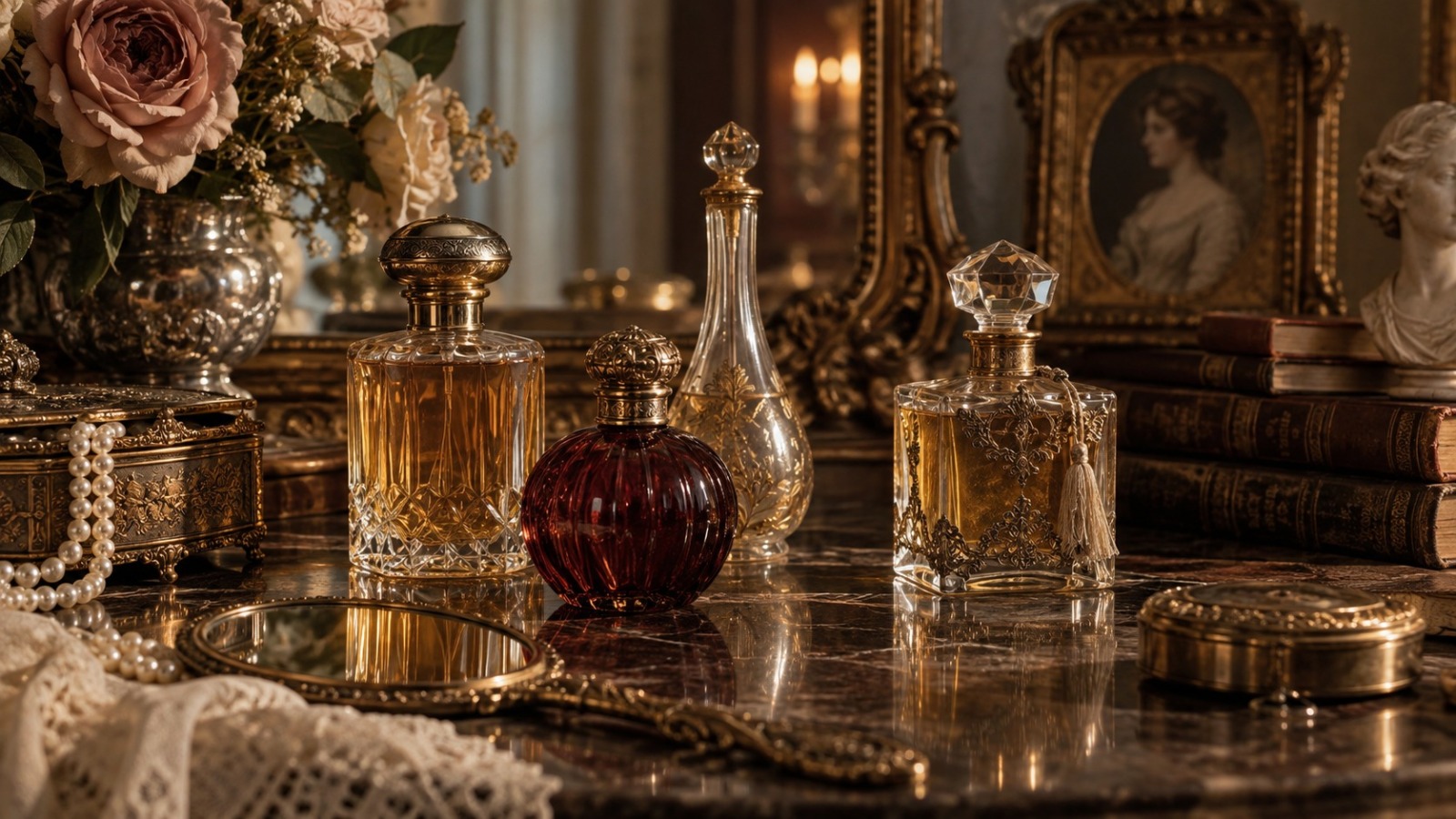
Old perfume brands attract interest for more than nostalgia. A historic house can preserve formulas, archives, bottle designs, manufacturing knowledge, and a recognizable olfactory language across generations. But age alone does not guarantee quality, continuity, or authenticity. Some brands have operated continuously; others have changed ownership, paused, revived, or reconstructed perfumes from archives.
This guide explains how to read perfume heritage critically, what reformulation really means, and how to distinguish a living tradition from a decorative date printed on a box.
What Counts as an Old Perfume Brand?
Several different ideas are often grouped under the phrase “old perfume brand”:
- A historic house: a company or institution with documented roots in an earlier era.
- A perfume with a long life: a named fragrance that has remained in production or has been reissued.
- A revived brand: a house that disappeared or paused and later returned under new ownership or artistic direction.
- A vintage bottle: an older physical production of a fragrance, which may smell different from the current version.
- A heritage-inspired brand: a modern company using historical references without direct continuity.
These categories are not interchangeable. A house may be centuries old while a particular fragrance is new. A famous perfume name may survive even though its formula, concentration, materials, packaging, or owner has changed.
Five Ways to Judge a Heritage Claim
1. Documented founding history
A credible heritage story should identify people, place, dates, and surviving records. Archives, advertisements, invoices, formulas, photographs, press coverage, and museum material are stronger than a vague claim such as “inspired by centuries of elegance.”
2. Continuity of the house
Continuous operation is one form of heritage, but it is not the only legitimate one. A revived house can still have real historical roots if it clearly explains the interruption, the ownership of the name, and what has been preserved or reinterpreted.
3. Continuity of the perfume
A fragrance sold under the same name may have changed. Ask whether the current product is the original formula, a compliant reformulation, an archival reconstruction, or a modern interpretation. Honest brands explain the distinction rather than hiding it behind the word “timeless.”
4. A recognizable creative language
Heritage becomes meaningful when it shapes the present: a particular treatment of florals, leather, amber, woods, powder, bottle design, couture references, or service. The past should be visible in decisions, not only in an anniversary date.
5. Current relevance
A historic house must still make products people can understand and wear. Preservation without interpretation becomes a museum exercise; reinvention without memory becomes ordinary branding.
Historic Houses That Shaped Modern Perfumery
The following examples illustrate different kinds of continuity. They are not a ranking of the “oldest” or “best.”
| House or fragrance | Documented milestone | Why it matters |
|---|---|---|
| Santa Maria Novella | The Florentine institution traces its history to 1221 | Shows how apothecary, botanical, home-fragrance, and personal-fragrance traditions can evolve within one long-lived identity. |
| Houbigant | Operating since 1775; Fougère Royale appeared in 1882 | Fougère Royale helped define the fougère family and demonstrates how one composition can influence an entire category. |
| Guerlain | Shalimar was composed in 1925 | Its bergamot-and-vanilla amber structure became a landmark in the language of amber perfumery. |
| CHANEL | N°5 launched in 1921 | Its abstract floral construction and presentation helped redefine what a modern fashion-house fragrance could be. |
| Maison IRFĒ | Founded in Paris in 1924 by Irina and Felix Youssoupoff | Represents a documented fashion-house legacy later revived and extended into contemporary fragrance. |
For the House’s own documented story, visit the Maison IRFĒ heritage page and the archival article on the Fashion House of IRFĒ.
Continuity, Revival, and Reconstruction
A useful way to understand heritage is to separate three paths.
Continuous house
The organization remains active across generations, even if ownership, perfumers, formulas, and distribution change. Continuity can preserve archives and know-how, but it does not mean every current bottle is chemically identical to an early edition.
Revived house
A dormant name returns with a new team. The revival can be serious when it uses documented archives and openly describes what is historical and what is new. Maison IRFĒ belongs to this conversation: the contemporary House draws on the Parisian fashion legacy founded in 1924 while creating products for the present.
Reconstructed fragrance
A formula is rebuilt from surviving records, analysis, or olfactory memory. Reconstruction is interpretation. Raw materials change, regulations evolve, and some details may be impossible to reproduce exactly.
The strongest heritage communication does not pretend these three paths are the same.
Why Old Perfumes Are Reformulated
Reformulation is often discussed as if it were simply a cost-cutting decision. In reality, formulas can change for several reasons:
- restrictions or updated safety standards for certain materials;
- changes in availability, quality, or sourcing;
- supplier and manufacturing changes;
- stability, color, or shelf-life requirements;
- new concentrations or regional product rules;
- an artistic decision to reinterpret the fragrance for current wearers.
A reformulation is not automatically worse. It may be lighter, cleaner, less animalic, more stable, or easier to wear. It can also lose texture or depth. The only reliable method is to compare the specific versions rather than treating the launch year as proof of identical smell.
Vintage Bottle Versus Current Edition
| Question | Vintage bottle | Current edition |
|---|---|---|
| Formula | May reflect an earlier production, but age can alter it | Current, regulated, and usually more consistent |
| Condition | Depends heavily on storage and seal | Usually predictable when bought from an authorized source |
| Availability | Limited and vulnerable to counterfeiting | Easier to sample and replace |
| Experience | Useful for collectors and historical comparison | Better for regular wear and understanding the house today |
Darkening, evaporation, a damaged atomizer, heat exposure, and oxygen can change a vintage perfume. An older bottle is not a perfectly preserved time capsule simply because it is sealed.
How to Buy Vintage Perfume More Safely
- Study the bottle and packaging. Compare typography, volume markings, batch codes, caps, labels, and box construction with documented examples.
- Ask about storage. A cool, dark cabinet is preferable to a sunny bathroom shelf or display window.
- Check the fill level. Significant evaporation can indicate a weak seal or long exposure.
- Be skeptical of perfect rarity. A supposedly scarce bottle appearing in endless identical listings deserves caution.
- Buy the seller, not only the bottle. Clear photographs, provenance, return terms, and specialist knowledge matter.
- Expect variation. Even authentic old bottles may differ because of batch, age, and storage.
For a broader discussion of older bottles and nostalgic scent styles, see our guide to vintage perfumes.
What Heritage Can Add to a Modern Perfume
History can deepen a fragrance when it provides a real creative framework. A fashion archive may influence silhouette, color, character, materials, bottle design, and the mood of a collection. A perfumery archive may preserve characteristic structures or methods.
Maison IRFĒ’s current fragrance collection connects the revived House with five distinct characters rather than reproducing a single antique formula. The result is contemporary perfume anchored in a documented identity. The fragrance story and the Maison IRFĒ Discovery Set provide a practical way to experience that present-day interpretation.
Heritage Red Flags
- A founding date appears everywhere, but no founders, location, archive, or chronology are provided.
- The brand implies continuous operation when there was a long interruption.
- A current formula is described as unchanged without documentation.
- Royal, aristocratic, or celebrity associations are repeated without a source.
- “Vintage” is used merely to describe a powdery or ornate aesthetic.
- The story is elaborate, but the modern product has no identifiable creative connection to it.
Why Archives Matter
An archive does more than prove age. It can show how a house described itself, which clients it served, how bottles and garments were made, and how its visual language changed. Archives also expose discontinuities. A gap in production is not a scandal when it is acknowledged; it becomes a problem only when marketing quietly converts revival into uninterrupted continuity.
For a revived house, making that history legible online also depends on a clear editorial content strategy that separates documented heritage from present-day interpretation.
For consumers, archival evidence helps separate a specific story from generic period decoration. A dated advertisement, surviving sketch, formula record, press clipping, or photographed garment carries more weight than a mood board of chandeliers and gold lettering.
Should You Prefer the Oldest House?
No. A younger independent perfumer may create a more thoughtful fragrance than a historic name trading mainly on recognition. Heritage is one dimension of value. Formula, materials, creative clarity, service, and personal response still determine whether a perfume deserves space in your collection.
Frequently Asked Questions
Does an old perfume brand always use the original formulas?
No. Formulas may be reformulated, reconstructed, or newly created. A historic name and an unchanged formula are different claims.
Are vintage perfumes stronger than modern perfumes?
Sometimes they feel denser, but age, evaporation, concentration, and material changes make simple comparisons unreliable.
Is a revived perfume house authentic?
It can be. Authenticity depends on documented rights, archives, transparency, and the seriousness of the contemporary interpretation.
Why do two bottles with the same perfume name smell different?
They may come from different formulas, concentrations, batches, factories, storage conditions, or stages of aging.
Should heritage determine what I buy?
Heritage can add meaning, but wearability, quality, and personal response remain more important than age alone.
Final Takeaway
The best old perfume brands do not merely preserve a date. They make the past legible in the present. Look for documented history, honest explanation of continuity or revival, a recognizable creative language, and products that still reward close attention. Heritage is most persuasive when it can withstand questions.
